Strong writing and strong optimization still matter, but even the best SEO content writing tips can only take you so far if you are not measuring what actually happens after a page goes live. Rankings improve faster when you know which pages attract the right traffic, which ones lose momentum, and which ones create engagement without producing leads. That is where analytics becomes one of the most useful parts of a serious SEO strategy. At Advanced Digital Media Services, SEO reporting and performance analysis are part of how we help businesses turn search visibility into real growth. In a market like Denver, where businesses across downtown, the Tech Center, and the wider Front Range all compete for attention online, analytics gives you a clearer way to decide what to improve instead of guessing.
Start by Tracking the Right SEO Analytics
Before analytics can help you improve rankings, you need to know which numbers deserve your attention. Too many businesses open a dashboard, see traffic totals, and assume that is enough. It usually is not.
How to use analytics to improve rankings with the right KPIs
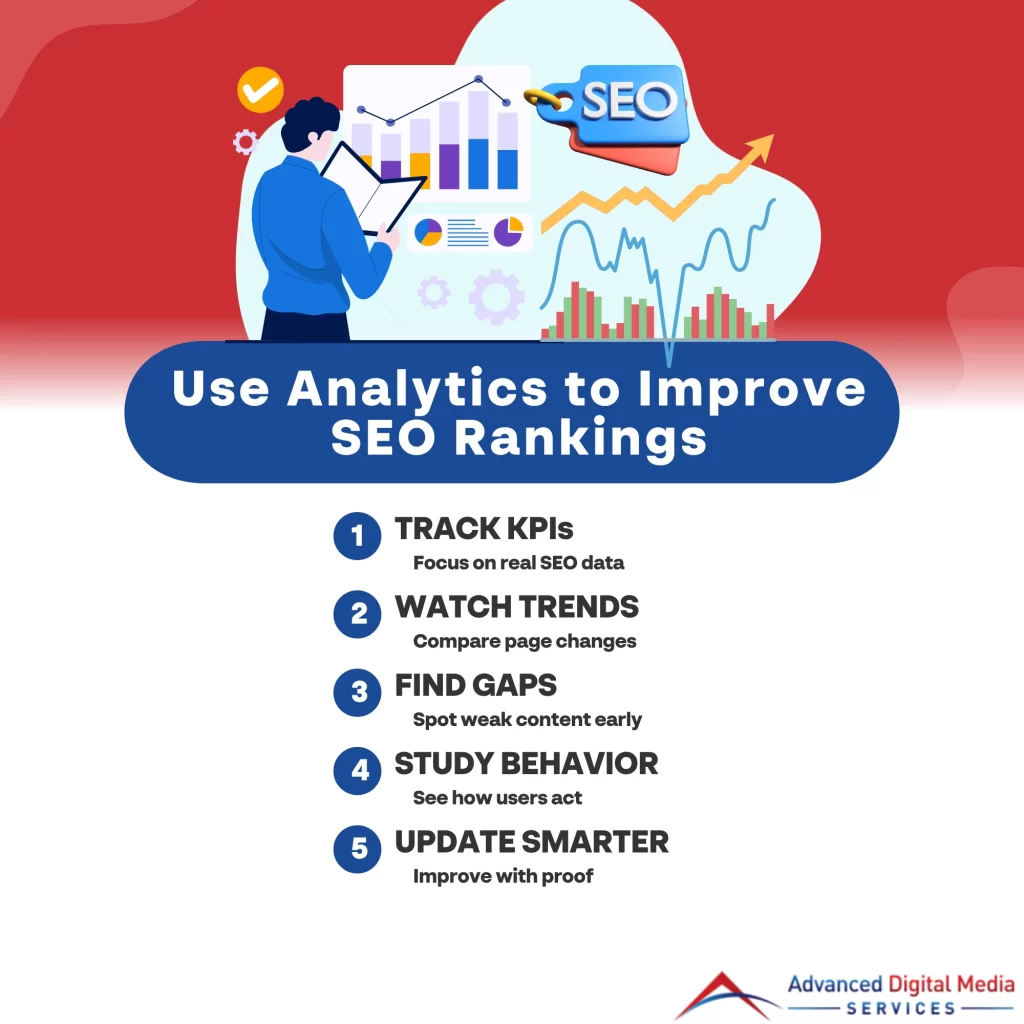
If you want to understand how to use analytics to improve rankings, start with metrics that connect directly to search performance. Organic sessions, landing page traffic, click-through rate, engagement, conversions, and ranking movement all tell a more useful story than vanity numbers alone. The goal is not to watch everything. It is to watch the numbers that actually help you decide what to update, expand, or fix.
Which SEO analytics for rankings matter most to website owners
The most valuable SEO analytics for rankings usually depend on the role of the page. A blog post may be measured by organic traffic growth and engagement. A service page may matter more for conversion rate, bounce patterns, and qualified visits. That is why one-size-fits-all reporting often falls short. Good analytics should help you understand whether the page is doing its specific job, not just whether it is being seen.
Use Google Analytics to Understand Organic Traffic Trends
Once the right metrics are in focus, the next step is understanding how those patterns change over time. Analytics becomes more useful when you compare performance instead of looking at one isolated snapshot.
How Google Analytics for SEO reveals top-performing pages
Google Analytics for SEO helps you see which pages consistently attract organic traffic and which pages are quietly gaining traction. That information matters because your best-performing pages often reveal what topics, formats, and search intent your audience responds to most. This is where content strategy gets more practical. Instead of assuming what should work, you can see what already is working and build from there.
What traffic drops and engagement changes can signal
A drop in traffic does not always mean something is broken, but it usually means something has changed. The same is true for lower engagement, shorter sessions, or sudden exit spikes on a once-stable page. Sometimes the issue is competition. Sometimes the content is outdated. Sometimes, the searcher’s expectations changed, and the page did not keep up. Analytics helps you catch those shifts earlier.
Find Ranking Opportunities Through Page-Level Data
Not every useful SEO insight comes from your top pages. Some of the best opportunities live in the middle of the pack, where a page already has traction but has not fully converted that attention into results.
How to identify pages with traffic but low conversions
A page may bring in steady visits and still under perform as a business asset. If users land there, read, and leave without taking action, the issue may be in the content structure, call to action, or how well the page matches intent. This is why page-level analysis matters. It helps you spot the difference between visibility and effectiveness.
How to spot underperforming content that needs optimization
Underperforming content often shows clear signs once you look closely. Maybe it ranks but does not earn clicks. Maybe it gets clicks but loses engagement. Maybe it once performed well and slowly slipped as competitors published stronger versions. At Advanced Digital Media Services, this is one of the places where analytics becomes especially useful. It helps you identify pages worth improving before they disappear into the background.
Measure User Behavior to Improve SEO Performance
Rankings are influenced by more than keyword placement and backlinks. User behavior matters too, because it helps reveal whether the page is actually helping the visitor.
Why bounce rate, engagement time, and exits matter for rankings
Bounce rate, time on page, engagement, and exit behavior all offer clues about content quality and relevance. If users leave, skip key sections, or fail to engage, the page may not be meeting expectations as well as it should. These signals should not be read in isolation, but together they can tell you whether a page feels useful, frustrating, clear, or incomplete.
How user behavior data helps improve page quality and relevance
Behavior data helps you move beyond assumptions. Instead of saying a page “looks fine,” you can see how real users actually interact with it. That often leads to better changes. A stronger intro, clearer headings, more direct answers, or a better call to action can improve how the page performs because it improves the experience itself.
Combine Analytics with SEO Strategy Adjustments
Analytics is only valuable if it leads to action. Once you understand what the data is showing, the next step is turning those insights into actual improvements.
How to turn analytics insights into content and on-page updates
If a page ranks but does not convert, the solution may be stronger messaging or better alignment with search intent. If a page gets impressions but not clicks, the meta title and description may need work. If engagement drops, the content itself may need a clearer structure or fresher examples. This is where analytics connects directly to optimization. The numbers help point you toward updates that have a real reason behind them.
Why regular reporting helps refine rankings over time
SEO improvement rarely comes from one big adjustment. More often, it comes from steady refinement. Regular reporting helps you compare patterns, identify what changed, and make smarter decisions month after month.That longer view matters, especially in competitive markets. Denver businesses competing along the I-25 corridor or across crowded local service categories usually need consistency, not guesswork.
Why Local Businesses Need Clear SEO Reporting
For local companies, SEO should never feel disconnected from business goals. Rankings matter, but only if they support the kind of visibility that leads to calls, form fills, appointments, or qualified traffic.
How SEO analytics in Denver, Colorado can support better decisions
Strong SEO analytics Denver Colorado businesses rely on should help answer practical questions. Which service pages are gaining traction? Which locations are improving? Which topics are drawing in the right audience? That kind of reporting is useful because it supports decisions you can actually act on. It gives business owners a clearer understanding of where momentum is building and where attention is still needed.
Why website analytics in Denver, Colorado should connect to real business goals
Good website analytics Denver Colorado businesses review should not stop at traffic totals. It should connect performance data to leads, conversions, and page value over time. At Advanced Digital Media Services, that connection is a major part of how we think about analytics. Reporting should not just be interesting. It should help you make better marketing decisions.
Improve Your Rankings with SEO Analytics Support from Advanced Digital Media Services
If you want a clearer picture of what your SEO is doing and where your biggest ranking opportunities are, we are here to help. At Advanced Digital Media Services, we use reporting, analytics, and search strategy together so you can make smarter decisions with your content and your website. You can reach us at (303) 529-1112 or visit our Colorado office at 600 17th Street, Suite 2800 South, Denver, CO 80202. Whether you need better reporting, stronger optimization, or a more complete SEO plan, we would be glad to help you move forward with more clarity and confidence.
FAQ
What is the best way to use analytics to improve rankings?
The best way is to focus on pages, keywords, and user behavior together instead of looking at one metric alone. Analytics becomes much more useful when it helps you decide what to update, expand, or fix based on real performance patterns.
Which SEO analytics matter most for rankings?
The most important metrics usually include organic traffic, engagement, click-through rate, landing page performance, and conversion behavior. The exact mix depends on the type of page and what you want that page to accomplish.
Can Google Analytics help with SEO even if it does not show keyword rankings directly?
Yes, absolutely. It helps you understand what users do after arriving on the site, which pages perform best, and where content starts losing momentum, all of which support stronger SEO decisions.
Why do local businesses need SEO reporting?
Because local businesses need to know more than whether traffic is rising. They need to know whether the right audience is finding them and whether their website is helping turn visibility into actual business results.
How often should SEO analytics be reviewed?
Monthly reporting is a good baseline for most businesses, though some campaigns may need more frequent review. The key is staying consistent enough to spot changes before they become larger problems.
Takeaways
Analytics gives you a clearer way to improve SEO because it replaces assumptions with evidence. It shows which pages are earning traffic, which ones are slipping, and where user behavior signals that the experience needs work. Even strong SEO content writing tips become more effective when they are supported by real performance data. If you want better rankings, analytics should not be treated like an afterthought. It should be one of the tools guiding your content updates, your on-page improvements, and your next strategic move.