A website can lose visibility fast when its SEO strategy leans too hard on shortcuts. Websites get penalized by Google, usually comes down to trust, quality, and user experience. Search engines want to show pages that help people, not pages built only to chase rankings. For business owners in St. Petersburg and the wider Tampa Bay area, that loss can be painful. Fewer search impressions can indicate fewer calls, fewer form fills, and less local visibility during busy buying seasons. Advanced Digital Media Services helps businesses avoid that risk through SEO, content strategy, technical audits, and website improvements built for long-term search performance.
Why Websites Get Penalized by Google
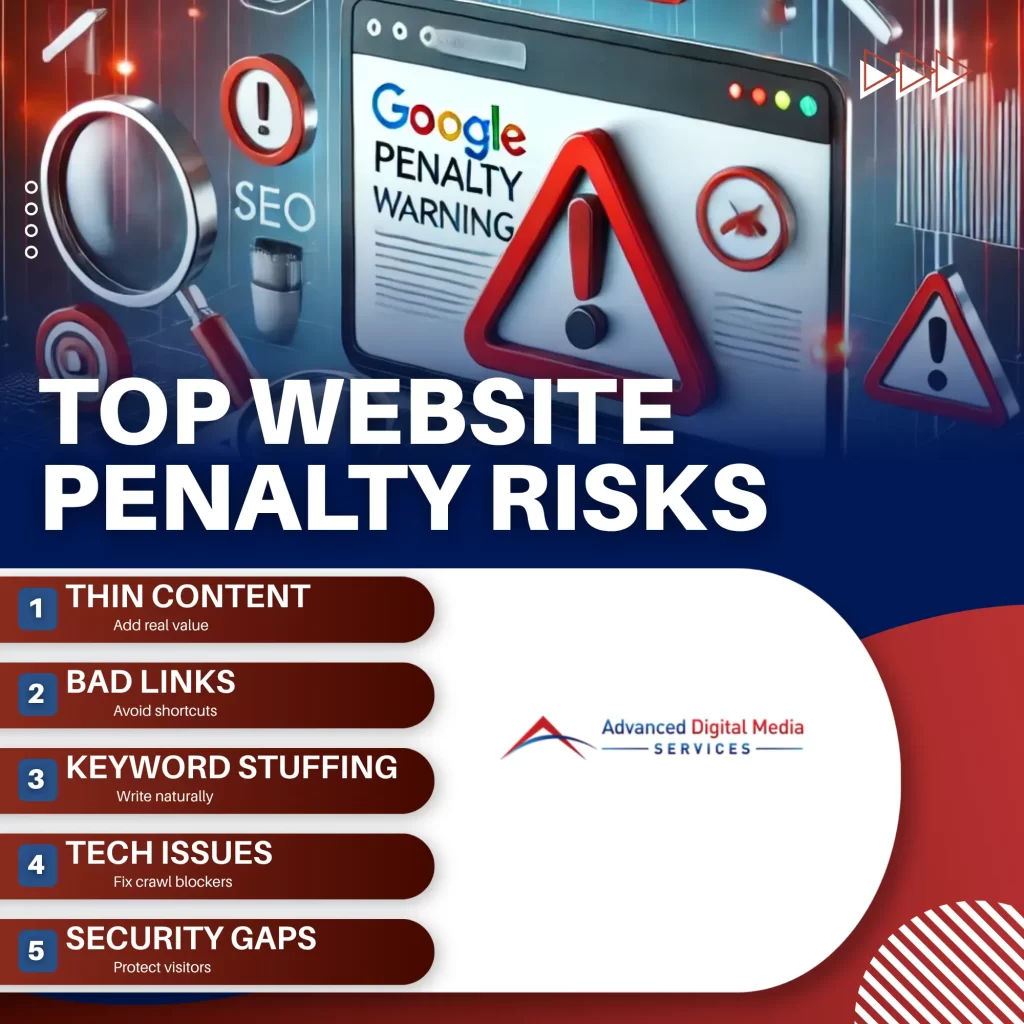
Google penalties for websites can happen when a site appears to manipulate search results or gives users a poor experience. Some issues are obvious, while others build slowly over time through weak content, poor links, or ignored technical problems.
Thin content that does not help the reader
Thin content is not just short content. It is content that does not answer the searcher’s question, explain the topic clearly, or offer a useful next step. A page with vague service copy, copied descriptions, or filler paragraphs may struggle because it gives Google very little reason to trust it. A local business page should explain what you offer, who you help, where you serve, and what makes your solution useful. A visitor looking for help in downtown St. Petersburg, Clearwater, or nearby Tampa Bay communities should not have to guess whether your business is relevant to them.
Manipulative link building that looks unnatural
Backlinks can help SEO, but risky link schemes can create serious problems. Paid links, link farms, spammy guest posts, and unrelated directory blasts can make a site look like it is trying to game the system. Healthy link building grows from useful content, real partnerships, local mentions, and trustworthy resources. If your website has years of questionable links, a careful review should be part of your broader search engine optimization plan.
Technical Problems That Make a Site Look Risky
A site can have strong content and still lose ground if technical issues block Google from crawling, reading, or trusting the pages. Technical SEO is often where hidden problems sit for months before a business notices the traffic drop.
Crawl errors, hacked pages, and broken links
Broken links, crawl errors, redirect chains, and hacked pages can weaken the way Google understands your site. These issues also hurt visitors. If someone clicks from a search result and lands on an error page, trust drops quickly. Tampa Bay businesses often depend on mobile searches from people comparing options between appointments, errands, beach traffic, and work breaks. A clean site structure helps those users reach the right page without friction. A routine website SEO audit can catch these problems before they become larger ranking issues.
Slow mobile pages that frustrate users
Slow pages can push visitors away before they ever read your offer. Large images, outdated plugins, weak hosting, and cluttered code often make the problem worse. Florida’s storm season can also remind business owners how much customers rely on fast mobile access. If someone is searching from a phone during a power outage, commute, or sudden change in plans, a slow site may lose that lead to a competitor. A faster, mobile-friendly site supports both SEO and real customer behavior.
Content and SEO Habits That Can Trigger SEO Penalties
SEO penalties often come from patterns, not one small mistake. A few awkward keywords will not ruin a website, but repeated attempts to manipulate rankings can create risk.
Keyword stuffing and hidden text
Keyword stuffing makes content hard to read. It also sends the wrong signal. Repeating the same phrase unnaturally in headings, paragraphs, image alt text, and footers can make a page feel built for bots instead of people. Hidden text is another risky tactic. Some older websites still have outdated SEO tricks buried in templates, such as tiny text, invisible links, or blocks of keywords hidden from users. These should be removed and replaced with helpful, visible content.
Duplicate pages and doorway content
Duplicate pages are common on local service websites. A business may create nearly identical city pages, swap only the location name, and hope each page ranks. That approach can look like doorway content if the pages do not provide unique value. For example, a St. Petersburg page should speak to local needs in a meaningful way. It might reference the business district, local service expectations, seasonal search habits, or nearby communities when helpful. Advanced Digital Media Services often looks at content quality, structure, links, and technical health together because one weak area can affect the rest.
How Local Businesses Can Reduce Google Penalty Risk
Avoiding penalties is not about being afraid of SEO. It is about using SEO in a way that supports real users and builds trust over time.
Keep local pages accurate and useful
Local pages should include accurate service details, clear contact information, and content that matches what nearby customers need. If you are comparing SEO services St. Petersburg, FL businesses can rely on, look for a team that understands both local search behavior and technical website health. A strong local page should not repeat the same paragraph across every city. It should explain why the service matters in that area and guide the reader toward a useful action.
Review your website before busy seasons
Many businesses wait until rankings drop before checking their website. A smarter move is to review your site before a busy season, launch, promotion, or major redesign. Look for outdated claims, thin pages, broken links, spammy backlinks, duplicate content, and slow mobile performance. If your site has already lost visibility, Google penalty recovery usually starts with finding the cause, fixing the issue, and rebuilding quality signals over time. Helpful resources like How to Fix SEO Issues can also help you understand what to check first.
Takeaways
Google rewards websites that help users, load well, stay secure, and follow ethical SEO practices. Most penalty risks come from thin content, manipulative links, duplicate pages, hidden tactics, or technical neglect. A stronger website starts with honest content, clean structure, useful local pages, and regular reviews. When SEO supports real people first, your rankings have a better chance of lasting.
##Frequently Asked Questions
What is a Google penalty?
A Google penalty is a loss of search visibility tied to a violation or quality issue. Some penalties are manual actions, while other traffic drops may come from algorithm updates or technical problems.
Are all traffic drops caused by penalties?
No, not all traffic drops are caused by penalties. Traffic can drop because of seasonality, stronger competitors, tracking changes, technical errors, or algorithm updates. A full review helps separate a true penalty from normal search movement.
Can bad backlinks hurt my website?
Yes, spammy or manipulative backlinks can create risk. A backlink review can help identify patterns that may weaken trust and guide a safer cleanup plan.
How often should I audit my website?
Most businesses should review their site at least a few times a year. Sites that often publish, run advertisements, or depend heavily on organic leads may need more frequent checks.
Can a penalized website recover?
Yes, many websites can recover after the root problem is fixed. Recovery may take time because Google needs to recrawl pages, reassess signals, and see consistent improvement.
Protect Your Rankings with Advanced Digital Media Services
If your website depends on Google traffic, penalty prevention should be part of your SEO plan, not a last-minute repair. Advanced Digital Media Services can review your content, technical setup, local SEO signals, backlinks, and site structure to help reduce risk and improve long-term visibility. For help understanding why websites get penalized by Google or for a practical website SEO audit, contact Advanced Digital Media Services at (727) 201-5296 or visit the Florida office at 360 Central Avenue Suite 800, St. Petersburg, FL 33701.