To improve your rankings, focus on optimizing content for search intent by incorporating relevant keywords. Don’t overlook technical elements like title tags and meta descriptions—they’re your first impressions. Enhance user engagement with smooth navigation, internal linking, and speedy load times. Also, clear calls to action can guide visitors effectively. By prioritizing these on-page SEO techniques, you’ll boost your site’s visibility and traffic. There’s much more to explore in maximizing your strategy for success.
Key Takeaways
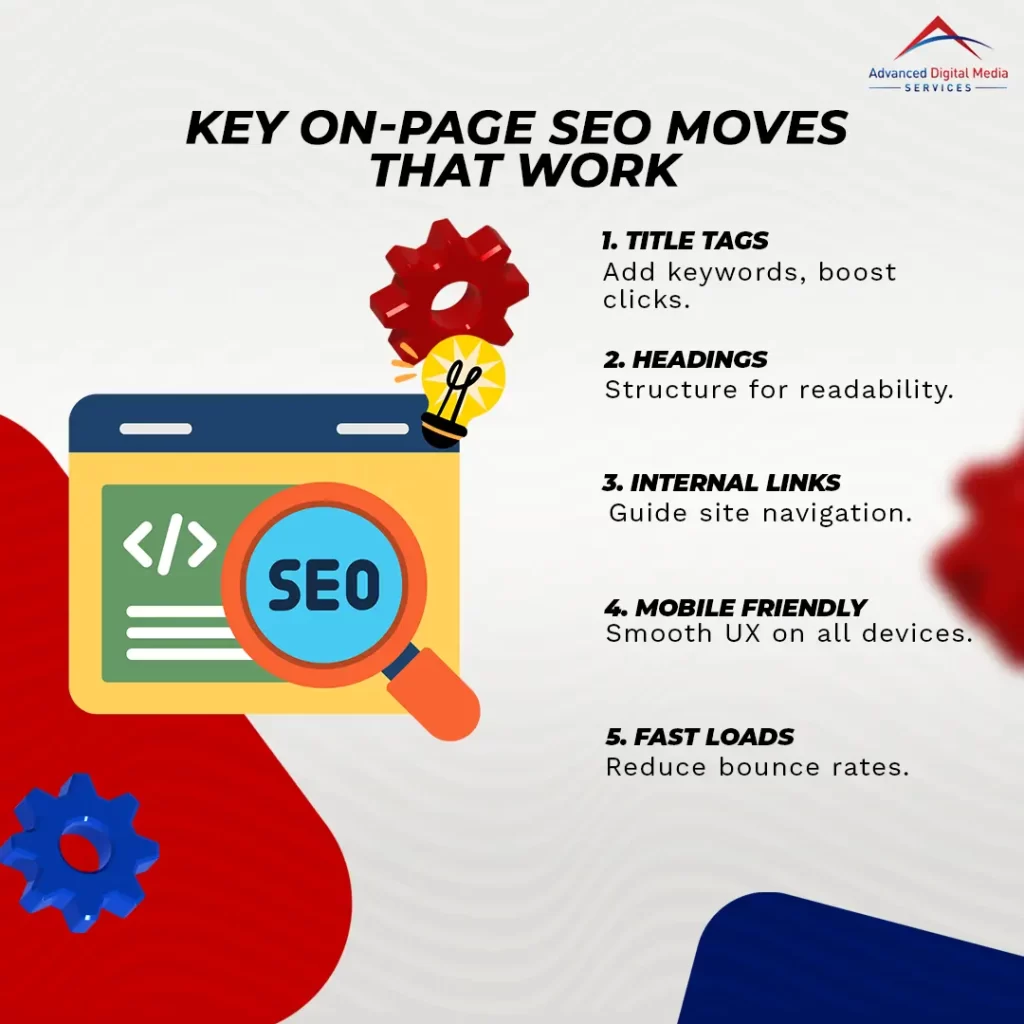
- Optimize title tags and meta descriptions with relevant keywords to enhance click-through rates and improve search visibility.
- Structure content with clear headings and subheadings to improve readability and engagement for users and search engines.
- Implement internal linking to guide users through your site and encourage longer engagement and exploration of additional content.
- Ensure your website is mobile-responsive and loads quickly to enhance user experience and reduce bounce rates.
- Utilize keyword research to align content with user search intent and incorporate keywords naturally throughout the text.
Why On-Page SEO Is Critical for Your Website’s Success
On-page SEO is essential because it shapes how search engines evaluate your pages and determine their rankings. When you optimize for user experience, you not only make your site more enjoyable to navigate but also boost your chances of climbing the search results. Understanding this connection can greatly impact your website’s success.
How search engines evaluate your pages
Search engines act like diligent librarians, meticulously evaluating your web pages to determine their relevance and quality. They analyze various factors, including keyword usage, content structure, and page load speed. To enhance your rankings, you should implement effective keyword optimization strategies. This means using relevant keywords naturally within your content, headings, and meta descriptions. Additionally, they look for high-quality, engaging content that answers users’ queries and encourages them to stay on your page. User engagement metrics, such as bounce rate and time spent on the page, also play a significant role. By focusing on these aspects, you can guarantee your pages align with search engines’ criteria, boosting your visibility and ultimately driving more traffic to your website.
The connection between user experience and rankings
When you prioritize user experience, you’re not just creating a more enjoyable website; you’re also boosting your search engine rankings. Search engines like Google increasingly consider user experience as a key factor in their algorithms. If visitors find your site easy to navigate, load quickly, and mobile-friendly, they’ll likely spend more time on it, reducing bounce rates. This positive interaction signals to search engines that your site is valuable, improving your SEO ranking. Additionally, well-structured content, clear calls-to-action, and engaging visuals enhance user experience, encouraging conversions. By focusing on user experience, you’re not just enhancing satisfaction; you’re strategically positioning your website for better visibility and success in search results. Prioritize user experience to elevate your SEO efforts.
Optimize Your Content for Search Intent
To optimize your content for search intent effectively, you should start by using keyword research to identify what your audience is looking for. Next, structure your content with clear headings and guarantee it’s easy to read. This approach not only enhances user experience but also boosts your chances of ranking higher in search results.
Using keyword research to guide topics
Understanding how to optimize your content for search intent is essential for driving relevant traffic to your website. One of the best ways to achieve this is by using keyword research to guide topics. By identifying the keywords and phrases your audience is searching for, you can create content that aligns with their needs and interests. Start by using tools like Google Keyword Planner or SEMrush to find popular search queries related to your niche. Once you’ve gathered this data, brainstorm content ideas that incorporate these keywords naturally. This approach not only helps improve your rankings but also guarantees your content resonates with your readers, keeping them engaged and encouraging them to take action.
Structuring content with headings and readability in mind
Creating well-structured content is essential for enhancing readability and engaging your audience effectively. By using header tag optimization, such as H1, H2, and H3 tags, you can easily organize your content and guide readers through your main points. Each header should clearly reflect the section’s content, making it easier for users to skim and understand. Additionally, incorporating keywords in these headers can improve your SEO. Don’t forget about image alt text for SEO; it not only helps with accessibility but also provides search engines with context about your visuals. Overall, a focus on structure and readability guarantees your content resonates with your audience while boosting your chances of ranking higher in search results.
Technical On-Page SEO Elements You Can’t Ignore
When it comes to on-page SEO, you can’t overlook the technical elements that make a difference. Title tags, meta descriptions, and proper header tags play a vital role in attracting clicks and improving your site’s structure. Plus, optimizing images with alt text boosts both accessibility and SEO, ensuring your content reaches a wider audience.
Title tags and meta descriptions that attract clicks
Title tags and meta descriptions serve as your website’s first impression in search results, making them essential for attracting clicks. To optimize your meta titles and descriptions, follow some best practices. Keep your title tags under 60 characters and guarantee they include primary keywords. For meta descriptions, aim for around 150-160 characters, providing a compelling summary of your content while incorporating relevant keywords. Use action-oriented language to encourage clicks, and consider adding a unique selling proposition to stand out. Avoid duplication; each page should have its own distinct title and description. By adhering to these meta title and description best practices, you’ll not only improve your click-through rates but also enhance your site’s SEO performance.
Proper use of header tags (H1, H2, H3)
Header tags, essential for organizing content, play a crucial role in on-page SEO. The proper use of header tags (H1, H2, H3) helps structure your content, making it easier for both users and search engines to navigate. Start with one H1 tag for your main title, followed by H2 tags for main sections, and H3 tags for subsections. This hierarchy enhances content readability, guiding readers through your material seamlessly. Additionally, search engines like Google use these tags to understand your content’s context, which can improve your rankings. Remember, clear and concise headers not only boost SEO but also keep your audience engaged. So, implement header tags effectively to maximize both user experience and search visibility.
Image optimization with alt text for accessibility and SEO
One of the key aspects of on-page SEO that often gets overlooked is image optimization, which includes the essential use of alt text. When you optimize images, you not only enhance user experience but also boost your SEO efforts. Alt text serves as a description for your images, helping search engines understand their content. This is critical for image optimization with alt text for accessibility and SEO. By including relevant keywords in your alt tags, you improve your chances of ranking higher in image searches. Additionally, alt text guarantees that visually impaired users can still grasp the context of your images, making your site more inclusive. So, don’t skip this step—optimize your images and reap the benefits for both accessibility and SEO.
Improving User Engagement Signals
To improve user engagement signals on your site, you’ll want to focus on a few key elements. Internal linking can guide visitors seamlessly through your content, while boosting site speed and mobile responsiveness keeps them coming back. Don’t forget clear calls to action; they can greatly reduce bounce rates and encourage users to explore more.
Internal linking to guide visitors through your site
While many factors influence user engagement on your website, effective internal linking plays an essential role in guiding visitors through your content. By establishing a clear internal linking structure, you help users navigate seamlessly from one page to another, keeping them engaged longer. This not only enhances their experience but also signals to search engines that your site is well-organized and relevant. Use descriptive anchor text that indicates what users can expect when they click a link. Prioritize linking to your most valuable pages, such as high-converting products or cornerstone content. As visitors explore your site, they’re more likely to find what they need, leading to increased time spent on your site and lower bounce rates.
Boosting site speed and mobile responsiveness
Site speed and mobile responsiveness are crucial elements that greatly impact user engagement on your website. If your pages take too long to load, users are likely to bounce, leading to higher abandonment rates. To keep visitors engaged, focus on improving page load speed by optimizing images, reducing server response time, and minimizing HTTP requests. Additionally, make sure your site is responsive, so it displays perfectly on all devices. This means using flexible layouts and scalable images. A fast, mobile-friendly website not only enhances user experience but also signals to search engines that your site is valuable. By prioritizing these aspects, you’ll encourage visitors to stay longer and interact more, ultimately boosting your search rankings.
Clear calls to action that reduce bounce rates
Effective calls to action (CTAs) can greatly reduce bounce rates by guiding users toward the next steps you want them to take. When your website features clear calls to action that reduce bounce rates, it encourages visitors to engage more deeply. Here are some tips to create effective CTAs:
- Use action-oriented language
- Position CTAs prominently on the page
- Make certain they’re visible on a mobile-friendly website design
- Limit the number of CTAs to avoid overwhelming users
- Test different styles and placements for effectiveness
Boost Your Rankings with Advanced Digital Media Services
If you’re looking to boost your search engine rankings, Advanced Digital Media Services has got your back. With expert on-page and off-page SEO strategies tailored just for your business, you’ll uncover hidden opportunities through thorough audits. Contact us today, and let’s start improving your online visibility together!
Expert on-page and off-page SEO strategies tailored to your business
To enhance your online visibility and drive more traffic to your website, implementing expert on-page and off-page SEO strategies is essential. Here’s how you can tailor these strategies to fit your business:
- Create an SEO-friendly url structure for better indexing.
- Optimize title tags and meta descriptions for targeted keywords.
- Use high-quality, relevant content to engage users and boost dwell time.
- Build quality backlinks through guest posts and partnerships.
- Leverage social media platforms to share content and increase reach.
Comprehensive audits to uncover hidden opportunities
While many businesses focus on optimizing their content and backlinks, thorough audits reveal hidden opportunities that can greatly boost your website’s performance. By examining your site’s structure and content, you can identify issues like duplicate content that may be hindering your rankings. Implementing canonical tags can help solve these problems, ensuring search engines understand your preferred versions of pages. Regular audits also highlight areas for improvement, such as underutilized keywords or slow-loading pages, which can greatly impact user experience. By addressing these hidden opportunities, you’re not just enhancing your site’s SEO; you’re also improving overall user engagement and satisfaction. So, invest in detailed audits to access your website’s full potential and elevate your rankings effectively.
Contact us today to start improving your search engine rankings
Releasing your website’s full potential doesn’t stop at audits; it’s just the beginning. To truly enhance your search engine rankings, you need a thorough strategy that includes advanced techniques like schema markup for search engines.
Here’s how we can help you:
- Optimize your content for relevant keywords
- Implement schema markup for better visibility
- Improve website loading speed and mobile responsiveness
- Enhance user experience through intuitive design
- Monitor and adjust your strategy based on analytics
Contact us today to start improving your search engine rankings. At Advanced Digital Media Services, we tailor our approach to meet your unique needs, ensuring you get the results you desire. Don’t wait—let’s elevate your online presence together!
Frequently Asked Questions
How Often Should I Update My On-Page SEO Strategies?
You should update your on-page SEO strategies regularly, ideally every few months. Keeping up with algorithm changes and industry trends guarantees your content remains relevant and effective, ultimately helping you maintain or improve your search rankings.
What Tools Can Help Analyze My On-Page SEO Performance?
You can use tools like Google Analytics, SEMrush, and Moz to analyze your on-page SEO performance. They provide insights into keyword rankings, page speed, and user engagement, helping you optimize your content effectively.
Can On-Page SEO Affect My Website’s Loading Speed?
Think of your website as a finely tuned engine; on-page SEO can greatly affect its loading speed. Optimizing elements like images and scripts guarantees a smoother, faster experience for your visitors, enhancing overall performance.
How Do I Choose the Right Keywords for My Content?
To choose the right keywords for your content, think about your audience’s search intent, use keyword research tools, analyze competitors, and focus on relevance and search volume. It’ll help your content get discovered more effectively.
What Role Do Meta Tags Play in On-Page SEO?
Meta tags enhance on-page SEO by providing search engines with essential information about your content, improving click-through rates with compelling descriptions, and optimizing your site’s visibility through targeted keywords. They’re vital for effective digital marketing.
Conclusion
To have your website rank at the top of search results, just recall: strategically incorporate relevant keywords, refine your meta tags for maximum impact, and keep users engaged for as long as possible. The alternative is a poorly performing site that resembles a dated design, which is almost as undesirable as a site that struggles to rank.