User experience matters for Search Engine Optimization (SEO) rankings because it changes how people behave on your site. If visitors can find what they need fast, on any device, they stick around, click deeper, and convert. Those engagement signals (along with speed and mobile usability) help search engines understand your site is worth showing. In this guide, you’ll learn the UX elements that most directly support SEO, and what to fix first if rankings or leads are slipping.
Key Takeaways
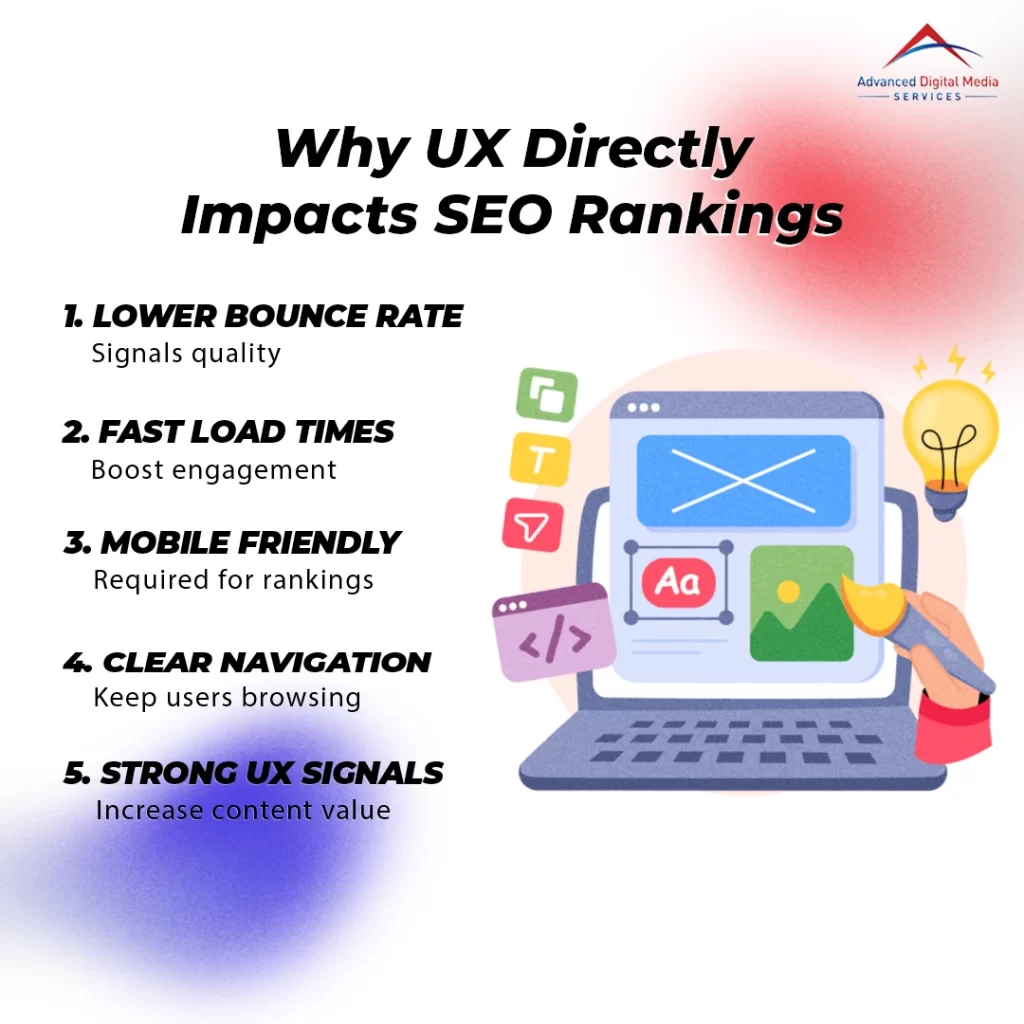
- Positive user experience reduces bounce rates, indicating to search engines that the site is valuable and relevant.
- Engaged users who spend longer on a site signal high-quality content, boosting SEO rankings.
- Fast load times enhance user experience, leading to improved engagement and higher search visibility.
- Intuitive navigation helps retain visitors and encourages further exploration, positively influencing search performance.
- Mobile-friendly designs cater to increasing smartphone users, which is essential for maintaining competitive SEO rankings.
Why User Experience Impacts SEO Rankings
User experience plays an essential role in your SEO rankings, especially for businesses in Colorado. When your site’s design and usability are excellent, it not only keeps visitors engaged but also boosts your visibility in search results. Let’s explore how UX design directly affects your search rankings and overall online presence.
Understanding user experience and SEO for Colorado businesses
When considering the relationship between user experience and SEO rankings, it becomes clear that a well-designed website not only attracts visitors but also keeps them engaged. For Colorado businesses, understanding user experience and SEO can greatly impact your online presence. A seamless user experience often leads to stronger engagement, like more pages viewed and longer time on site, which can correlate with better search performance because users are finding value. If you’re leveraging SEO services in Colorado focused on user experience, you’ll likely see improved rankings as visitors find what they need quickly and easily. Investing in user-friendly design and intuitive navigation can make all the difference in capturing and retaining your audience. Ultimately, prioritizing user experience is essential for enhancing SEO outcomes and driving business growth.
UX design impact on search rankings and visibility
A well-crafted UX design can greatly influence your website’s search rankings and visibility. When you prioritize user experience, you’re likely to see improved engagement metrics, like lower bounce rates and longer session durations. Search engines notice these positive signals, which can enhance your rankings. The ux design impact on search rankings is significant; a user-friendly site not only satisfies visitors but also aligns with search engine algorithms that favor quality interactions. Additionally, intuitive navigation and fast load times contribute to a seamless experience, further boosting your visibility. By investing in effective UX design, you’re not just creating a better experience for users; you’re also positioning your site to rank higher in search results.
Website Usability and Performance Factors
When it comes to SEO, website usability plays an essential role in your rankings. If your site isn’t easy to navigate or mobile-friendly, you might be missing out on valuable traffic and conversions. Optimizing these factors can greatly enhance both user experience and your overall SEO performance.
Website usability and SEO performance improvements
While enhancing your website’s usability, you’re also boosting its SEO performance. When users find your site easy to navigate, they’re more likely to stay longer and engage with your content. This reduced bounce rate signals search engines that your site is valuable, improving your rankings. Key factors like fast load times, intuitive layouts, and clear calls-to-action contribute to better website usability. By streamlining user experience, you not only meet visitors’ expectations but also align with SEO performance metrics that search engines prioritize. Additionally, optimizing your site for accessibility ensures that all users can interact with your content, further enhancing usability. Ultimately, investing in website usability translates directly into improved SEO performance, making your site more competitive online.
Mobile-friendly design for higher SEO rankings
Creating a website that works well on mobile devices is essential for boosting your SEO rankings. A mobile-friendly design for higher SEO rankings ensures your site loads quickly, is easy to navigate, and looks great on smaller screens. With more users accessing websites through smartphones, search engines prioritize mobile-optimized sites in their rankings. This means if your site isn’t responsive, you risk losing potential traffic.
Additionally, a seamless mobile experience leads to lower bounce rates and higher engagement, both of which signal to search engines that your site is valuable. By focusing on mobile usability, you not only enhance user experience but also improve your chances of climbing the search engine results pages. Prioritize mobile design to secure your online presence.
Optimizing Speed and Engagement for SEO
When it comes to improving your SEO, site speed optimization is key. Fast-loading pages not only enhance user experience but also boost your search engine rankings. Plus, high user engagement signals to search engines that your content is valuable, making it essential to keep your visitors hooked.
Site speed optimization Colorado SEO experts recommend
To enhance user experience and boost SEO rankings, site speed optimization is essential for any business looking to thrive online. Colorado SEO experts recommend several strategies to improve your site’s performance. Start by compressing images and leveraging browser caching, which can greatly reduce loading times. Minimize HTTP requests by simplifying your website design and merging files when possible. Additionally, consider using a Content Delivery Network (CDN) to deliver content more efficiently to users across the globe. Regularly monitor your site’s speed using tools like Google PageSpeed Insights to identify areas for improvement. By implementing these site speed optimization techniques, you’ll not only enhance user satisfaction but also increase your visibility on search engines, ultimately leading to greater success. From a UX perspective, Google pays attention to page experience signals like Core Web Vitals, which reflect how fast content appears, how quickly the page responds, and whether the layout jumps around while loading.
How user engagement affects SEO rankings
While many factors influence SEO rankings, user engagement stands out as a critical element. When users spend more time on your site, interact with your content, and explore multiple pages, it signals to search engines that your site is valuable. This is how user engagement affects SEO rankings. High engagement rates can lead to lower bounce rates and increased dwell time, both of which are favorable for your site’s visibility. Additionally, when users share your content or return to your site, it boosts your credibility. To optimize for engagement, focus on creating compelling content, improving site navigation, and ensuring fast load times. Ultimately, prioritizing user engagement not only enhances the experience but also elevates your SEO performance.
UX-Driven Digital Marketing Strategies
When you’re looking at UX-driven digital marketing strategies, it’s essential to understand how companies in Colorado are enhancing user experiences. By implementing better UX practices, you can considerably improve your bounce rate and keep visitors engaged longer. Let’s explore how these strategies can elevate your online presence and drive results.
UX-driven digital marketing strategies Colorado companies use
As businesses in Colorado endeavor to stand out in a competitive digital landscape, leveraging user experience (UX) in their marketing strategies has become essential. Here are four key UX-driven digital marketing strategies Colorado companies use:
- Responsive Design: Ensuring websites look great on all devices boosts user engagement.
- User-Centric Content: Creating valuable and relevant content encourages visitors to stay longer.
- Fast Loading Times: Optimizing website speed reduces bounce rates and improves satisfaction.
- Intuitive Navigation: Streamlining site navigation helps users find what they need quickly.
Improving bounce rate with better UX practices
To improve your website’s bounce rate, implementing better UX practices is vital. Start by ensuring your site loads quickly; slow load times can drive visitors away. Simplifying navigation helps users find what they need without frustration. Use clear visuals and engaging content that resonates with your audience, as this keeps them on your page longer. Additionally, optimizing for mobile devices is essential, as more users browse on smartphones. Consistently maintaining a clean design and reducing clutter enhances the overall user experience. By focusing on these strategies, you’re not just improving bounce rate with better UX—you’re also fostering a loyal audience that’s likely to convert. Remember, a positive user experience directly impacts your SEO rankings, so prioritize it!
SEO-Friendly Web Design and Testing
When it comes to SEO-friendly web design, Colorado businesses need to focus on both aesthetics and functionality. You’ll want to implement UX testing to ensure your site not only attracts visitors but also keeps them engaged for better SEO success. Let’s explore how these elements work together to enhance your online presence.
SEO-friendly web design Colorado businesses need
While many businesses recognize the importance of a visually appealing website, it’s crucial to remember that SEO-friendly web design is equally important for success in today’s digital landscape. For Colorado businesses, focusing on these key elements can enhance your online presence:
- Responsive Design: Verify your site looks great on all devices, from desktops to smartphones.
- Fast Loading Speed: Optimize images and minimize code to reduce loading times and improve user experience.
- Clear Navigation: Make it easy for visitors to find what they’re looking for, keeping them engaged longer.
- Quality Content: Create valuable, relevant content that incorporates keywords naturally to boost your SEO.
UX testing for SEO success: Colorado strategies
UX testing helps you see where users get stuck. Use heatmaps, session recordings, and analytics to identify friction points, then test improvements with A/B tests where possible. Surveys can also reveal what users expected but didn’t find. What to test first (highest impact): Navigation labels (do people understand where to click?) Above-the-fold clarity (what you do + whom you help + next step) Form length and friction (fewer fields usually converts better) Internal link placement (add “next step” links mid-page, not only at the bottom)
Navigation and Local SEO Considerations
When it comes to website navigation, you need to evaluate how it impacts both user experience and SEO. Optimizing your navigation can improve your local SEO efforts, especially if you’re targeting audiences in Colorado. By aligning these elements, you can create a seamless experience that helps boost your online visibility.
Website navigation and SEO optimization techniques
Effective website navigation not only enhances user experience but also plays a crucial role in SEO optimization, helping search engines understand your site’s structure. Here are some techniques to improve your website navigation and SEO optimization:
- Clear Hierarchy: Organize your content logically, making it easy for users and search engines to navigate.
- Descriptive Labels: Use clear, keyword-rich labels for your navigation links to improve contextual relevance.
- Internal Linking: Create internal links between related pages, boosting SEO and guiding users to important content.
- Mobile Optimization: Confirm your navigation is responsive and user-friendly on all devices, as mobile-friendliness impacts rankings.
Local SEO Colorado and user experience alignment
Local SEO in Colorado requires a strategic approach to align user experience with search engine optimization. You need to ensure your website is user-friendly, mobile-responsive, and easy to navigate, as these factors play a vital role in local search rankings. When potential customers search for services in your area, they expect quick access to relevant information. By optimizing your site for local SEO Colorado, you not only improve visibility but also enhance user experience. This means incorporating local keywords, creating location-specific content, and making sure your contact information is easily accessible. The better the user experience, the more likely visitors will convert into customers, driving your business’s growth and success in the competitive local market.
Colorado UX and local SEO quick wins: Put your city and primary service in the H1 and page intro (example: “Denver Web Design” or “Colorado SEO Services”). Make phone, address/service area, and contact buttons tap-friendly on mobile. Add a short “Why us in Colorado” trust block with local cues (service area list, reviews, photos, or team info). Use internal links from blogs to relevant service pages so users can take the next step.
Partner with Advanced Digital Media Services for SEO Solutions
Advanced Digital Media Services(https://advdms.com/contact-us/) helps Colorado businesses improve rankings by fixing the UX issues that quietly hold sites back, such as slow pages, confusing navigation, weak mobile layouts, and conversion friction. You’ll get an SEO plan built around real user behavior, plus design and performance improvements that support long-term visibility. If you want better traffic and better leads, UX-driven SEO is the fastest way to align both.
Frequently Asked Questions
How Does Mobile Responsiveness Affect User Experience and SEO?
Mobile responsiveness greatly enhances user experience, ensuring your site’s visually appealing and functional across devices. This not only keeps visitors engaged but also improves your SEO, as search engines favor mobile-friendly websites for higher rankings.
What Role Does Content Layout Play in User Engagement?
Content layout’s like a well-structured map; it guides users smoothly through your site. When it’s clear and engaging, you’ll keep visitors interested longer, boosting interaction and encouraging them to return for more.
Can User Feedback Improve Website Design for SEO?
Yes, user feedback can greatly improve your website design for SEO. By understanding visitors’ needs and preferences, you can make adjustments that enhance usability, leading to better engagement and higher search rankings over time.
How Often Should I Update My Website for a Better User Experience?
You should update your website whenever something is outdated or causing friction, and you should review performance at least quarterly. For most businesses, that means refreshing key service pages, improving internal links, and updating content as offerings or customer questions change.
What Tools Can Help Analyze User Experience on My Site?
To analyze user experience on your site, consider tools like Google Analytics, Hotjar, and Crazy Egg. They provide insights into user behavior, track engagement, and help identify areas for improvement to enhance overall user satisfaction.
Conclusion
User experience is one of the most practical ways to improve SEO because it improves what users do on your site, and it supports speed, mobile usability, and clear site structure. If your rankings are stuck, don’t just publish more content; fix the UX blockers that cause drop-offs. Start with speed, navigation, mobile layout, and clear “next step” paths, and you’ll usually see better engagement and stronger search visibility over time