Better web design can improve your website rankings because Google favors sites that are easy to use, fast, and mobile-friendly. Focus on user experience with clean pages that are simple to read, make sure everything is mobile-first so it works great on phones, and speed up load times so people don’t bounce. A clear, SEO-friendly architecture (organized menus, logical pages, and internal links) also helps search engines understand your site, which can boost visibility.
Key Takeaways
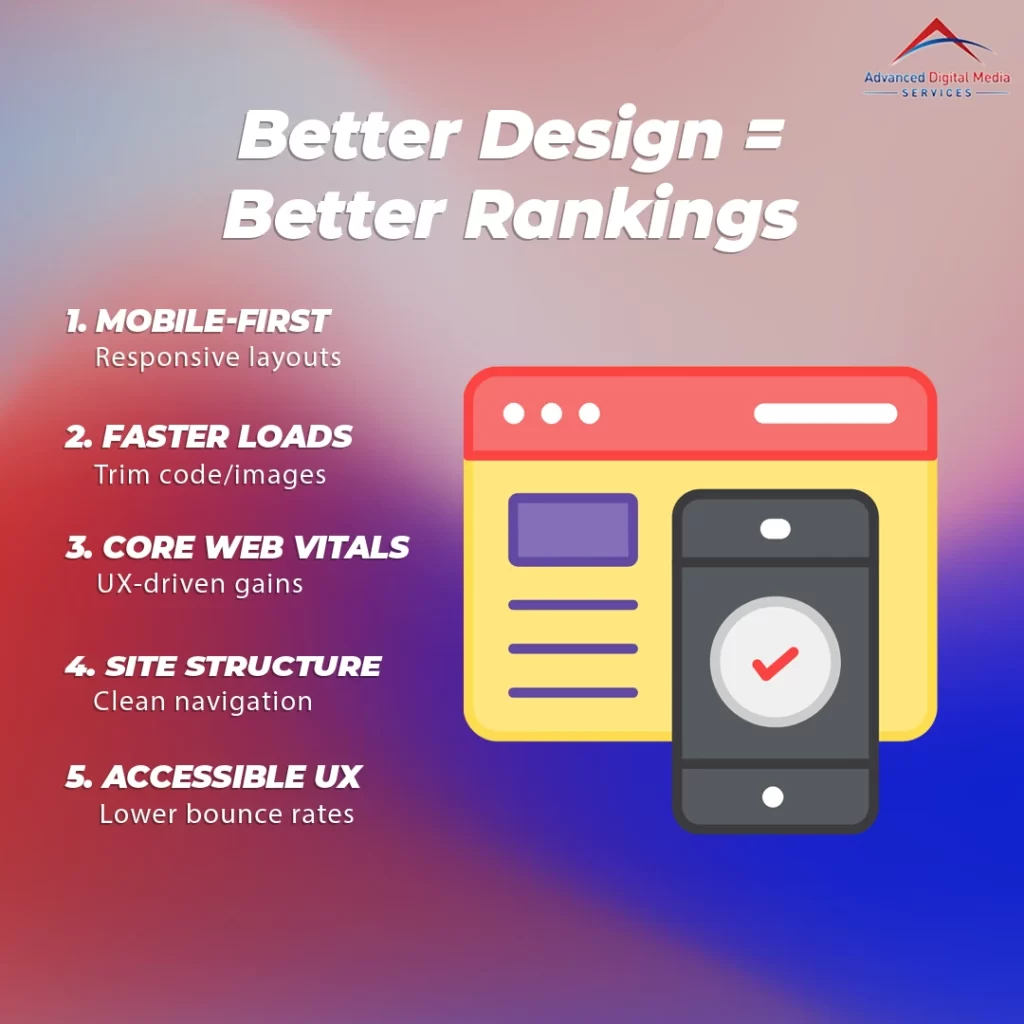
- Implement a mobile-first and responsive design to enhance usability across devices, improving user engagement and Google rankings.
- Optimize site speed by minimizing code and compressing images, as faster websites retain visitors and rank higher in search results.
- Create a clean site structure with logical navigation and effective internal linking to improve crawling efficiency and user experience.
- Integrate on-page SEO elements, including relevant keywords in titles and meta descriptions, to enhance visibility and search engine indexing.
- Ensure ADA compliance for accessibility, which reduces bounce rates and signals quality to search engines, positively impacting rankings.
Understand How Web Design Impacts SEO
Web design plays an essential role in your site’s SEO rankings. A well-structured site not only enhances user experience but also meets important ranking factors that search engines consider. When you focus on design, you’re not just improving aesthetics; you’re boosting your visibility online.
How web design affects SEO rankings
When you think about improving your website’s SEO, don’t overlook the critical role design plays in the equation. How web design affects SEO rankings is significant, as a well-structured site enhances user experience and keeps visitors engaged. Clean layouts, easy navigation, and mobile responsiveness are essential elements that search engines prioritize. Additionally, optimized images and fast loading times contribute to better performance and lower bounce rates. When your design aligns with best practices, you’re more likely to see higher rankings. Remember, search engines favor sites that not only look good but also function well. So, investing in thoughtful design can be a game-changer for your SEO strategy and overall online success.
User experience and website ranking factors
While you might focus on keywords and content for SEO, user experience (UX) is just as essential for boosting your website’s ranking. Search engines prioritize sites that offer a seamless UX, as it reflects the quality of your content. If visitors find your site difficult to navigate or slow to load, they’re likely to leave quickly, increasing your bounce rate. This behavior signals to search engines that your site isn’t meeting user needs, negatively impacting website ranking factors. Ensuring your design is intuitive, responsive, and fast can enhance user satisfaction, encouraging longer visits and interactions. By improving user experience, you not only keep visitors engaged but also improve your chances of climbing the search engine results pages.
Build a Mobile-First, Responsive Website
To boost your Google rankings, a mobile-first, responsive website is essential. With more users accessing the web via mobile devices, prioritizing this design approach can enhance your search visibility. Embracing responsive design not only improves user experience but also signals to search engines that your site is modern and relevant.
Improving Google rankings with responsive design
Responsive design helps your site perform well on every screen size, which improves usability and sends stronger quality signals to Google. With more users accessing the web via mobile devices, Google prioritizes sites that adapt seamlessly to different screen sizes. By implementing responsive design, you enhance usability, which keeps visitors engaged and reduces bounce rates—key factors that influence search rankings. Furthermore, Google’s algorithms favor sites that provide a consistent experience across devices, making improving Google rankings with responsive design a smart strategy. Don’t forget to optimize your images and streamline your content for faster loading times, as speed is also essential for search visibility. Essentially, a responsive design not only boosts your rankings but also fosters a better connection with your audience.
Mobile-first web design for better search visibility
A mobile-first web design approach is vital for boosting your search visibility in today’s digital landscape. With more users accessing websites via mobile devices, search engines prioritize mobile-friendly sites. By implementing mobile-first web design for better search visibility, you’re ensuring that your website is optimized for smaller screens first, enhancing user experience across all devices. This strategy not only improves loading times but also increases engagement and reduces bounce rates, significant factors in search rankings. Ensure your site’s layout, content, and navigation are all tailored for mobile use. Additionally, utilizing responsive design techniques ensures your website adapts seamlessly to various screen sizes, further solidifying your visibility in search results. Embrace this approach to stay competitive and connect with your audience effectively.
Improve Site Speed and Core Web Vitals
To improve your site’s rankings, you need to focus on speed and Core Web Vitals. A fast-loading website not only enhances user experience but also boosts your SEO performance. By optimizing your design, you can ensure that your site meets these essential metrics, leading to better visibility and engagement.
Fast-loading website design to boost SEO
Speed is an essential factor in the digital landscape, greatly impacting both user experience and SEO performance. A fast-loading website design to boost SEO is vital for retaining visitors and reducing bounce rates. When your site loads quickly, users are more likely to stay engaged, explore more pages, and ultimately convert. Search engines also prioritize fast sites, improving your rankings in search results. To achieve this, optimize images, minimize code, and leverage browser caching. Remember, every second counts—if your website takes too long to load, you risk losing potential customers. By focusing on fast-loading design, you not only enhance user satisfaction but also set your site up for better visibility and success in search engine rankings.
Core Web Vitals optimization through better design
Core Web Vitals focus on how fast your main content loads (LCP), how responsive your site feels when someone clicks (INP), and how stable the layout is while loading (CLS). Better design choices, like properly sized images, fewer layout shifts, and lighter scripts, help you improve these signals so users stay longer and Google can rank you more confidently.
Use Clean Structure and SEO-Friendly Architecture
A clean site structure and effective internal linking are essential for boosting your SEO efforts. Not only does this improve your search performance, but it also enhances user experience, making your site more accessible. Plus, ensuring your website is ADA-compliant can widen your audience and contribute to better rankings.
Clean site architecture and internal linking for SEO
When crafting a website, establishing a clean site architecture and effective internal linking is essential for optimizing SEO. A well-organized site structure helps search engines crawl your pages efficiently, improving your rankings. A simple rule is to link from high-traffic pages (like your homepage or top service pages) to related supporting pages (like FAQs, case studies, or location pages). This helps search engines understand page relationships and helps users move naturally toward the next step. Start by creating a logical hierarchy with clear categories and subcategories, making it easier for users and search engines to navigate.
Internal linking for SEO is equally important; it connects related content, allowing users to explore your site further while distributing page authority. Use descriptive anchor text that reflects the linked content, enhancing user experience and boosting SEO. By prioritizing clean site architecture and effective internal linking, you’ll not only improve your search visibility but also create a more user-friendly experience that keeps visitors engaged.
ADA-compliant website design and search performance
Creating an ADA-compliant website not only enhances accessibility for users with disabilities but also improves your search performance. When you prioritize ADA-compliant website design, you’re ensuring that all users can navigate your site easily, which can lead to longer visit duration and lower bounce rates—both positive signals to search engines. Practical accessibility upgrades that also improve usability include: Clear color contrast for text and buttons Alt text for meaningful images Keyboard-friendly menus and forms
Moreover, an accessible website often features a clean structure and proper HTML tags, which are essential for SEO. By implementing these elements, you’re not just meeting legal requirements; you’re also optimizing your site for better indexing and ranking. Remember, a well-structured, ADA-compliant website design can enhance user experience, making it easier for search engines to crawl, ultimately boosting your overall search performance.
Redesign with SEO and Conversions in Mind
If your website feels outdated, it might be time for a redesign that boosts both your rankings and conversions. By focusing on a conversion-oriented design, you can align your site’s structure with SEO goals, making it easier for users to engage. This approach not only enhances user experience but also drives measurable results for your business.
Redesigning an outdated website to improve rankings
Redesigning an outdated website can greatly enhance your search rankings and conversions, especially when you prioritize SEO from the start. When you’re focused on redesigning an outdated website to improve rankings, consider implementing a clean, user-friendly layout that encourages engagement. Make sure your site’s navigation is intuitive, allowing visitors to find what they need quickly. Optimizing images, using fast-loading elements, and ensuring mobile responsiveness also play significant roles in your site’s performance. Don’t forget about on-page SEO; include relevant keywords in titles, headers, and meta descriptions. By integrating these practices during your redesign, you’ll create a platform that not only attracts more traffic but also converts visitors into customers, ultimately boosting your overall online presence.
Conversion-focused design that supports SEO goals
When you design your website with both conversions and SEO in mind, you’re setting the stage for success. Partnering with a conversion-focused web design agency in Denver, CO, can help you achieve this balance. Here are key aspects to take into account:
- User-Friendly Navigation: Make it easy for visitors to find what they need.
- Compelling Calls to Action: Use clear, persuasive language to guide users toward your goals.
- Mobile Optimization: Ensure your site looks great and functions well on all devices.
Integrate Design and SEO from the Start
When you start your website design, integrating SEO from the beginning is essential. Advanced Digital Media Services combines professional WordPress design with a strategic SEO approach, ensuring your site not only looks great but also ranks well. This seamless integration helps you achieve better visibility and higher conversion rates right from launch.
Professional WordPress design and SEO integration
Integrating design and SEO from the start can greatly enhance your WordPress website’s effectiveness. When you focus on professional WordPress design and SEO integration, you’ll set a solid foundation for success. Here are a few key aspects to contemplate:
- Responsive Design: Ensure your website looks great on all devices, improving user experience and search rankings.
- Optimized Content: Use relevant keywords and engaging visuals to attract both visitors and search engines.
- Fast Loading Times: Implement design elements that don’t compromise site speed, as performance is vital for SEO.
How ADMS combines web design and SEO strategy
To ensure your website achieves its full potential, ADMS seamlessly merges web design with SEO strategy from the outset. By integrating these elements, you maintain a user-friendly experience while optimizing for search engines. Their approach starts with understanding your business goals, allowing them to create visually appealing designs that adhere to SEO best practices. Whether you’re looking for tailored SEO web design services in FL or a complete digital overhaul, ADMS focuses on speed, mobile responsiveness, and intuitive navigation. This combination not only enhances user engagement but also boosts your search rankings. By prioritizing both design and SEO, you’ll see improved visibility and increased conversions, driving sustainable growth for your online presence.
Improve Your Website Rankings with Advanced Digital Media Services
If you want higher rankings and a better user experience, ADMS can help you align design, site structure, and SEO from day one. You’ll get a site that loads faster, works better on mobile, and is built to convert. Here’s how ADMS can help you:
- Custom Website Design: They’ll craft a visually appealing site that’s easy to navigate.
- SEO Strategies: Their team implements effective SEO techniques that boost your search rankings.
- Engaging Content: Quality content creation keeps visitors engaged and encourages conversions. Request a website SEO design review for impressive results.
Frequently Asked Questions
How Does Website Design Influence User Engagement and Behavior?
Website design considerably influences user engagement and behavior by creating an intuitive experience. When navigation’s easy, and visuals are appealing, users are more likely to stay longer, explore more, and interact with your content.
What Role Does Color Scheme Play in Website Effectiveness?
Color scheme greatly impacts your website’s effectiveness by influencing emotions and perceptions. When you choose the right colors, it can enhance user experience, improve readability, and encourage visitors to take desired actions on your site.
Can Typography Affect My Website’s SEO Performance?
Yes, typography can affect your website’s SEO performance. It influences readability and user experience, which impacts engagement metrics. When visitors stay longer and interact more, search engines notice, potentially boosting your rankings.
How Often Should I Update My Website Design for SEO?
A light refresh can happen anytime you change services or branding, but a full redesign is usually needed when your site is slow, not mobile-friendly, or hard to navigate. If Core Web Vitals, conversions, or rankings are slipping, it’s a good time to evaluate a design + SEO upgrade.
What Common Design Mistakes Harm Website Rankings?
Common design mistakes that harm your website rankings include slow loading speeds, poor mobile responsiveness, cluttered layouts, and excessive ads. Fixing these issues can greatly enhance user experience and improve your search engine visibility.
Conclusion
Better design is more than visual polish; it directly supports SEO by improving usability, speed, and site structure. If your website is outdated or underperforming, a design update that prioritizes mobile experience, clean navigation, and Core Web Vitals can help you earn stronger rankings and convert more visitors. When design and SEO work together, your site becomes easier to find, easier to use, and easier to trust.