Common meta tag mistakes can hurt your SEO performance. Missing or duplicate title tags can confuse both usrs and search engines, while titles that don’t align with search intent lead to poor click-through rates. Generic meta descriptions fail to capture interest, and keyword stuffing can trigger penalties. Finally, ignoring local SEO and brand consistency can dilute your message. By being aware of these issues, you can enhance your strategy and improve visibility; the following sections offer further insights.
What Is a Meta Tag and Why Does It Matter for SEO?
A meta tag is a snippet of text that describes a webpage’s content, typically found in the HTML source code. These tags play an essential role in influencing both search visibility and click-through rates by providing search engines and users with vital information about your page. Understanding how to optimize meta tags can greatly impact your site’s SEO performance.
What is a meta tag in simple terms
Meta tags are snippets of text that provide information about a webpage’s content to search engines and browsers. Fundamentally, they help define what a page is about, impacting how it appears in search results. Understanding what a meta tag is essential for effective SEO. A well-optimized meta tag can enhance visibility, while common meta tag mistakes, like missing or duplicate tags, can hinder your site’s performance. Properly utilized, meta tags can improve click-through rates, making them a significant component of your SEO strategy. Remember, the right meta tags not only inform search engines but also attract users, bridging the gap between meta tag and SEO effectiveness. Always review your meta tags to avoid pitfalls that could derail your online presence.
How meta tags influence clicks and search visibility
While many factors contribute to a webpage’s visibility in search results, meta tags play a pivotal role in attracting clicks and enhancing search engine optimization (SEO). A well-crafted meta tag example, such as an engaging title or description, can greatly influence a user’s decision to click on your link over competitors. SEO experts in Colorado emphasize the importance of including relevant keywords and maintaining ideal character limits to guarantee your meta tags are both informative and appealing. Additionally, unique meta tags for each page help search engines understand your content better, improving your chances of ranking higher. By avoiding common mistakes and fine-tuning your meta tags, you can enhance your search visibility and drive more traffic to your site.
Missing or Duplicate Title Tags
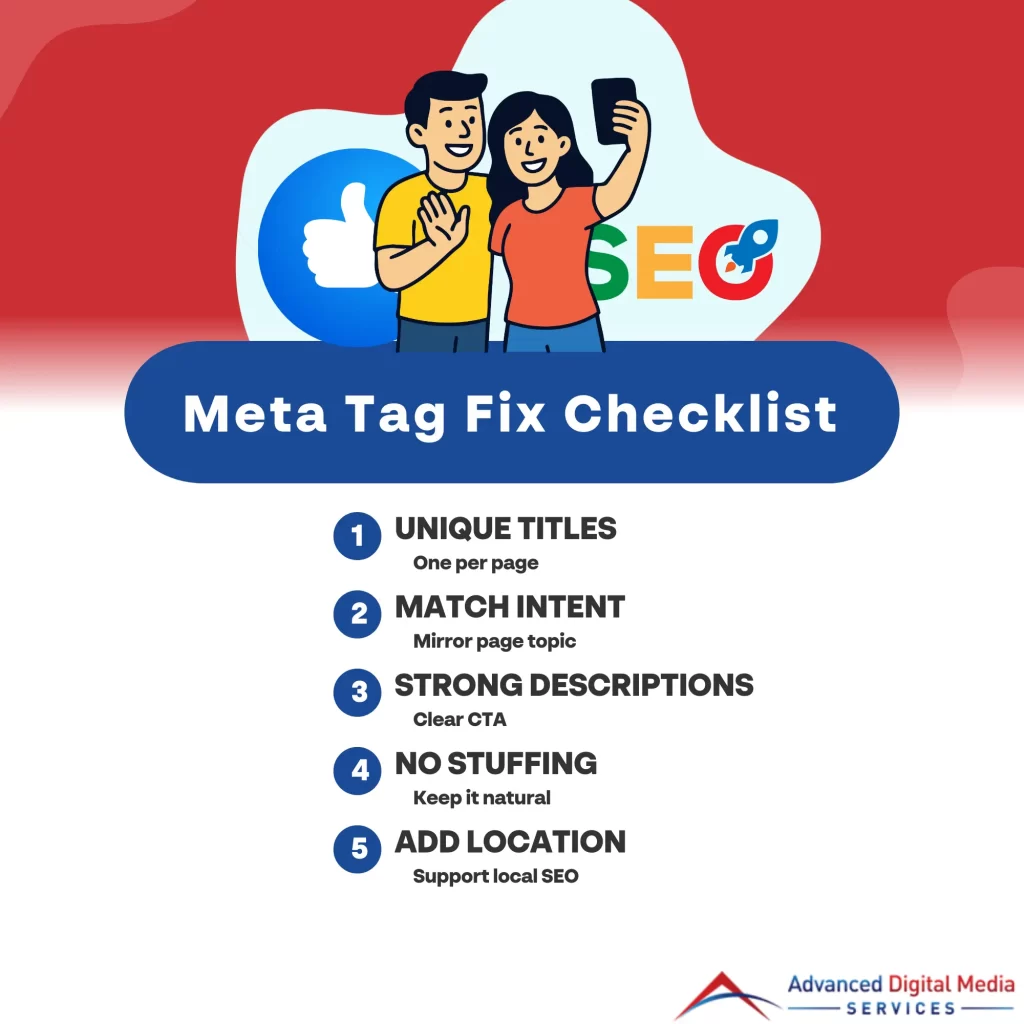
Missing or duplicate title tags can greatly hinder your website’s performance in search results. When search engines encounter multiple pages with the same title, it creates confusion, making it harder for both users and algorithms to determine the relevant content. To optimize your site, make sure every important page has a unique, descriptive title that aligns with its specific focus.
Why duplicate titles confuse search engines and users
Title tags are essential elements of on-page SEO, and having duplicate titles can lead to confusion for both search engines and users. When search engines encounter duplicate titles, they struggle to determine which page to rank higher, resulting in:
- Decreased visibility in search results
- Lower click-through rates due to user uncertainty
- Inefficient crawling, wasting search engine resources
- Mixed signals about the content’s relevance and authority
- Potential penalties from search engines for poor practices
How to write unique titles for every important page
Creating unique titles for every significant page is essential for effective SEO and user engagement, as each title serves as a distinct identifier for your content. To achieve this, start by incorporating relevant keywords that accurately reflect the page’s theme. Aim for clarity and brevity, keeping titles between 50-60 characters to guarantee full visibility in search results. Avoid generic phrases; instead, craft specific titles that resonate with your target audience. Additionally, prioritize your brand name at the end of the title when appropriate. Use tools like SEO plugins to analyze title effectiveness and ascertain uniqueness across your site. Regularly audit your titles to identify duplicates and make necessary adjustments, thereby enhancing both user experience and search engine rankings.
Writing Titles That Don’t Match Search Intent
When creating titles, it’s essential to align them with user search intent to improve SEO performance. A title that accurately reflects the page content not only enhances rankings but also meets user expectations. For instance, a strong meta tag clearly communicates the topic while enticing clicks, serving as an important element in your overall SEO strategy.
Meta tag and SEO alignment; matching the page topic
Although many businesses invest time in crafting compelling meta tags, they often overlook the critical alignment of these tags with search intent. This misalignment can lead to poor click-through rates and diminished SEO performance. To avoid this pitfall, consider these key points:
- Verify the meta title reflects the primary content topic.
- Use keywords that your target audience is actually searching for.
- Avoid vague or misleading descriptions that don’t match the page content.
- Regularly analyze user behavior and adjust tags as necessary.
- Test different meta descriptions to see which resonates best with users.
What a strong meta tag example looks like for rankings
Misalignment between meta tags and search intent can severely impact your rankings. A strong meta tag example should precisely reflect the content’s purpose while integrating relevant keywords. For instance, if your page is about “SEO strategies for small businesses,” your title tag should read: “Top 10 SEO Strategies to Boost Small Business Visibility.” This not only informs search engines about the page’s content but also aligns with user queries. Additionally, guarantee your meta description complements the title, providing a succinct summary that entices clicks. Avoid generic phrases like “click here” and instead use actionable language. By aligning your meta tags with user intent, you enhance relevance, improve click-through rates, and ultimately, boost your rankings.
Meta Descriptions That Don’t Drive Clicks
When crafting meta descriptions, many overlook the balance between keyword optimization and engaging content. You need descriptions that not only incorporate relevant terms but also entice users to click through. Failing to achieve this can lead to missed opportunities and lower click-through rates (CTR).
Common meta tag mistakes in description writing
One of the most common meta tag mistakes businesses make is writing descriptions that fail to engage users effectively. These descriptions often miss the mark, leading to lower click-through rates (CTR). Here are key pitfalls to avoid:
- Generic language: Using bland phrases that don’t convey value.
- Overly long descriptions: Exceeding the character limit and getting cut off in search results.
- Lack of a clear call to action**: Failing to prompt users to click through.
- Ignoring target audience: Not tailoring the message to the specific needs of potential customers.
- Keyword stuffing: Overloading the description with keywords, which can deter clicks.
How to write descriptions that boost CTR without stuffing keywords
Crafting effective meta descriptions requires a strategic approach that balances engaging content with SEO best practices. To boost your click-through rate (CTR), focus on creating concise, compelling descriptions that accurately reflect the page’s content. Use active language that encourages action, such as “Discover,” “Learn,” or “Unlock,” which can entice users to click. Instead of cramming keywords, incorporate them naturally within a clear, informative context. Aim for 150-160 characters to guarantee the entire description displays in search results. Additionally, consider your target audience’s pain points and desires; addressing these can increase relevance. Finally, experiment with A/B testing to analyze which descriptions perform better, allowing you to refine your approach for maximum CTR without compromising quality.
Keyword Stuffing and Over-Optimization
When you overload your meta tags with keywords, you can actually hurt your site’s performance instead of helping it. Striking a balance between optimization and readability is essential for maintaining user engagement. To keep your meta tags effective, focus on crafting natural, persuasive language that incorporates relevant keywords without sacrificing clarity.
When adding more keywords hurts performance
Although it might seem beneficial to pile on keywords in your meta tags to improve search rankings, doing so can actually backfire. Search engines are increasingly sophisticated, and keyword stuffing can lead to negative consequences that hurt your performance. Here are some pitfalls to take into account:
- Lower click-through rates: Searchers may find overly keyword-rich tags unappealing.
- Decreased relevance: Tagging with unrelated keywords can mislead users.
- Search engine penalties: Over-optimization might trigger penalties from search engines.
- Poor user experience: Cluttered tags can detract from valuable content.
- Diluted brand message: Your unique value proposition may get lost in keyword chaos.
Instead, focus on crafting concise, relevant meta tags that genuinely reflect your content and engage users effectively.
How to keep meta tags natural and persuasive
To keep meta tags natural and persuasive, it’s essential to strike a balance between optimization and readability. Focus on using relevant keywords that align with your content while ensuring they flow seamlessly within the tag. Avoid keyword stuffing; it can lead to penalties from search engines and alienate potential visitors. Instead, prioritize clarity and relevance. Use action-oriented language that encourages clicks, such as “discover,” “learn,” or “improve.” This not only enhances user engagement but also signals to search engines that your content is valuable. Regularly review and update your tags based on performance analytics; this helps maintain relevancy and effectiveness. Remember, a well-crafted meta tag can markedly impact your visibility and click-through rates without sacrificing natural language.
Ignoring Local SEO Signals and Brand Consistency
When optimizing your meta tags, don’t overlook the importance of local SEO signals. Including location cues for your Colorado and Florida audiences can greatly enhance relevance and visibility. Additionally, maintaining consistency in your titles and descriptions with your brand voice helps reinforce identity and trust.
Including location cues for Colorado and Florida audiences
While many businesses focus on broad marketing strategies, neglecting local SEO signals can severely undermine their efforts to connect with specific audiences, especially in distinct markets like Colorado and Florida. Including location cues in your meta tags is essential for improving relevance and visibility in these regions.
Consider the following strategies:
- Use geo-specific keywords in title tags and meta descriptions.
- Highlight local landmarks or attractions in your content.
- Incorporate state names or city names in your tags.
- Optimize your Google My Business profile with accurate location data.
- Create location-based landing pages for targeted campaigns.
Keeping titles and descriptions consistent with your brand voice
Maintaining consistency in your titles and descriptions with your brand voice is essential, as it directly impacts how potential customers perceive your business. Inconsistent messaging can confuse users, leading to distrust and lost opportunities. Your titles and descriptions should reflect your brand’s personality—be it professional, casual, or quirky—guaranteeing a cohesive experience across all platforms.
Utilize keywords that resonate with your audience while aligning with your brand tone. This balance enhances both SEO and user engagement. Regularly audit your meta tags to confirm they accurately represent your brand voice and mission. By prioritizing this alignment, you not only improve your search rankings but also foster brand loyalty, making it easier for customers to connect with your values and offerings.
Fix Meta Tag Issues with Advanced Digital Media Services in Colorado
Fixing meta tag issues is essential for optimizing your website’s search engine visibility, and Advanced Digital Media Services in Colorado is equipped to help you tackle these challenges effectively. Our expertise guarantees that your meta tags accurately reflect your content, improving click-through rates and search rankings.
Here’s how we can assist:
- Conducting thorough meta tag audits
- Crafting compelling title tags and descriptions
- Implementing structured data for enhanced visibility
- Monitoring and adjusting tags based on performance analytics
- Providing ongoing support for continuous optimization Optimizing your website’s search engine visibility is crucial, and Advanced Digital Media Services can expertly resolve your meta tag issues. So what are you waiting for? Connect with us today to find out how we can help with not just Meta tags but the whole SEO best practices.Takeaways
To summarize, optimizing your meta tags is essential for enhancing your website’s visibility and performance. Notably, studies show that 70% of users are more likely to click on search results with compelling title tags and meta descriptions. By avoiding common mistakes such as duplicate tags and mismatched search intent, you can greatly improve your click-through rates and conversions. Staying informed and strategic in your meta tag implementation can set your digital marketing strategy up for success.
Frequently Asked Questions
How Often Should I Update My Meta Tags?
You should update your meta tags regularly, ideally every few months or when significant changes occur in your content or target keywords. This keeps your SEO strategy relevant and aligned with user search intent.
Can Meta Tags Impact My Website’s Loading Speed?
Meta tags don’t directly impact your website’s loading speed. However, excessive or poorly optimized tags can increase HTML file size, potentially slowing down load times. Focus on efficient coding to enhance overall performance and user experience.
Are There Character Limits for Title Tags and Meta Descriptions?
Yes, title tags should ideally be under 60 characters, while meta descriptions should be around 150-160 characters. Research shows that concise tags improve click-through rates, enhancing your site’s visibility and engagement.
Do Different Search Engines Prioritize Meta Tags Differently?
Yes, different search engines prioritize meta tags differently. While Google emphasizes relevance and user intent, others might focus on specific keyword placements. Understanding these nuances helps you optimize your content for each platform effectively.
How Can I Track the Effectiveness of My Meta Tags?
You can track your meta tags’ effectiveness by using tools like Google Analytics and Search Console. Monitor click-through rates, impressions, and rankings to assess their impact on organic traffic and make necessary adjustments.