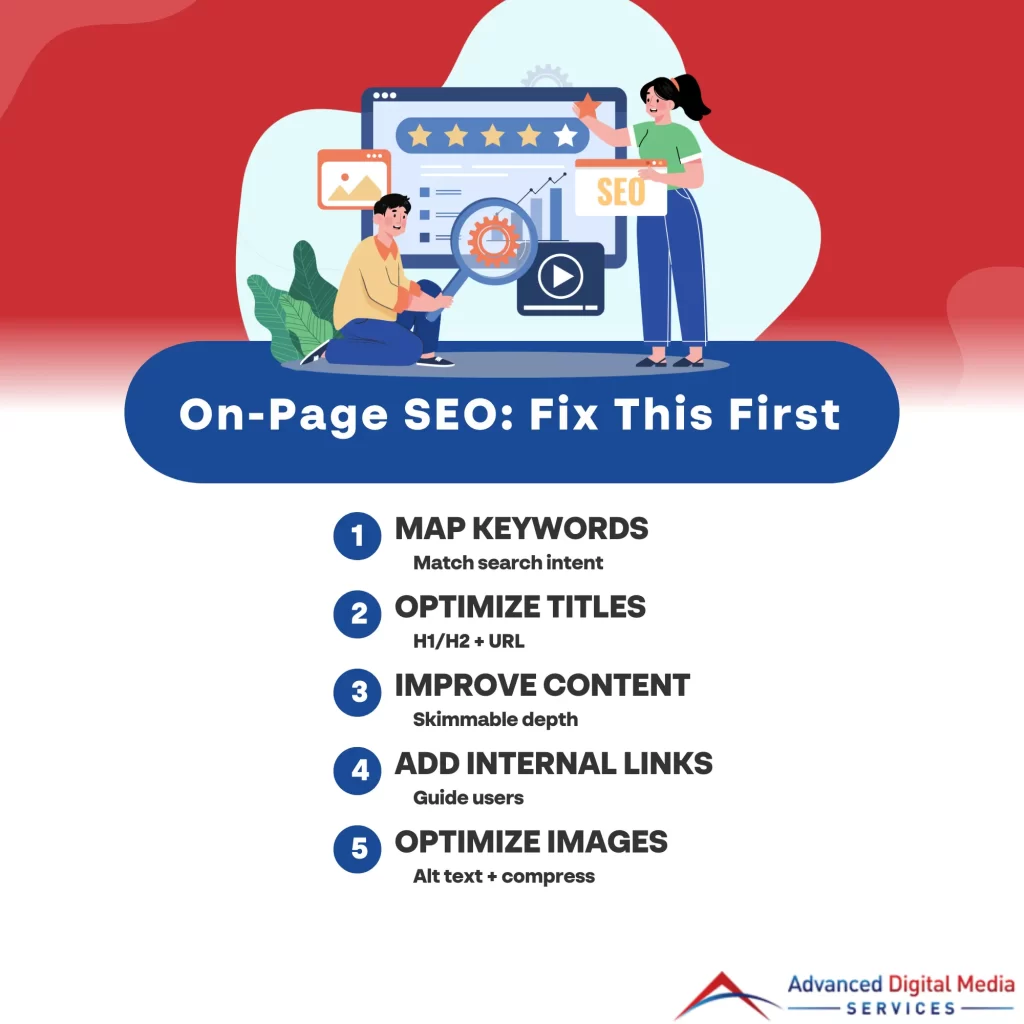
To optimize your content for on-page SEO, start by identifying relevant keywords and mapping them throughout your content. Make sure your page titles, headings, and URLs reflect user intent. Enhance the quality and depth of your content, ensuring it’s readable and skimmable. Strengthen internal linking to improve navigation and user engagement. Finally, optimize images with keywords and alt text for better visibility. There’s much more to explore to fully enhance your SEO strategy.
What Is On-Page SEO Content and Why Does It Matter?
On-page SEO content plays a critical role in determining your website’s search rankings and enhancing the user experience. It encompasses various elements, including keyword usage, meta tags, and structured data, all of which contribute to how both search engines and users perceive your page. Understanding these components will enable you to create a more effective strategy that not only attracts visitors but also keeps them engaged.
How on-page SEO affects rankings and user experience
While many factors influence search engine rankings, on-page SEO content plays a pivotal role in determining both visibility and user experience. When you effectively optimize your content for SEO, it not only improves your rankings but also enhances how users interact with your site. High-quality, relevant on-page SEO content keeps visitors engaged, reducing bounce rates and encouraging longer visits. This directly correlates to better rankings, as search engines prioritize sites that provide value to users. If you’re considering an on-page SEO service in Colorado, focus on strategies that align content with user intent and include relevant keywords. By understanding how to optimize content for SEO, you can create a seamless experience that drives traffic and boosts your online presence.
What “content for on-page SEO” includes on a page
Understanding what constitutes effective content for on-page SEO is vital for enhancing your website’s performance. This content includes not just the text on your page, but also metadata, headings, and images. Keywords should be strategically placed within the body to guarantee relevance and improve search visibility. Additionally, well-crafted meta titles and descriptions serve as the first impression in search results, enticing users to click. Don’t overlook the importance of internal linking; it enhances navigation and helps search engines understand your site’s structure. Finally, high-quality visuals that are optimized for fast loading times can greatly improve user experience, a key factor in ranking. Overall, thorough content for on-page SEO creates a seamless blend of information and engagement that drives traffic.
Start with Search Intent and Keyword Mapping
To effectively optimize your content, you need to understand search intent and how to map keywords strategically. Start by identifying primary and secondary keywords that align with what your audience is searching for, ensuring they fit naturally within your content. This approach not only enhances SEO but also prevents the pitfalls of keyword stuffing, allowing for a more engaging reader experience.
How to choose primary and secondary keywords per page
How can you effectively choose primary and secondary keywords for each page of your website? Start by analyzing search intent—what users are actually looking for when they enter specific queries. Use tools like Google Keyword Planner or Ahrefs to identify keywords with high search volume and relevance to your content. For your primary keyword, select one that encapsulates the main topic of the page. Then, identify secondary keywords that support this theme, ensuring they address related subtopics or variations. Map these keywords strategically throughout your content, focusing on headings, meta descriptions, and alt tags. This approach not only enhances SEO but also aligns your content with user expectations, increasing engagement and potential conversions.
How to optimize content for SEO without keyword stuffing
While optimizing content for SEO, it’s essential to focus on search intent and keyword mapping to guarantee your writing remains natural and engaging. To achieve this without keyword stuffing, consider these strategies:
- Understand Search Intent: Identify what your audience is looking for and tailor your content accordingly.
- Use Synonyms and Related Terms**: Incorporate variations of your primary keywords to maintain flow while covering the topic thoroughly.
- Employ Natural Language: Write as if you’re conversing with your audience, which helps in avoiding forced keyword placement.
- Leverage Semantic Keywords: Integrate related keywords that support your main topic, enhancing relevance without compromising readability.
Optimize Page Titles, Headings, and URL Structure
To enhance your on-page SEO, it’s essential to craft SEO-friendly H1s and H2s that align with user intent, as these elements signal the content’s relevance to search engines. Additionally, implementing clean URLs and adhering to best practices for internal page structure can greatly improve your site’s navigability and search visibility. By strategically optimizing these components, you’ll set a solid foundation for higher rankings and better user engagement.
Writing SEO-friendly H1s and H2s that match intent
Crafting SEO-friendly H1s and H2s that align with user intent is essential for optimizing your webpage’s visibility and engagement. To guarantee your headings effectively serve your audience and search engines, consider these strategies:
- Reflect User Intent: Use keywords that match what users are searching for.
- Be Descriptive: Clearly outline the content that follows, providing context.
- Keep It Concise: Aim for clarity; avoid overtly lengthy headings.
- Use Hierarchy Wisely: Organize content logically, with H1s for main topics and H2s for subtopics.
Clean URLs and internal page structure best practices
Given that search engines prioritize user experience, clean URLs and a well-structured internal page hierarchy play an essential role in on-page SEO optimization. Start by ensuring your URLs are concise, descriptive, and free of unnecessary parameters. Use hyphens to separate words, making it easier for both users and search engines to read. Next, establish a logical internal linking structure; this guides visitors through your site and helps search engines crawl effectively. Each page should be easily accessible within three clicks from the homepage. Additionally, employ a hierarchical heading structure (H1, H2, H3) to create a clear content flow. This not only enhances readability but also signals to search engines the importance of each section, boosting your SEO performance.
Improve Content Quality, Depth, and Readability
To enhance your content quality, focus on creating helpful, skimmable sections that capture and retain user interest. Incorporating FAQs and supporting details not only adds depth but also establishes your topical authority. By strategically structuring your content this way, you’ll improve both user engagement and search engine visibility.
Writing helpful, skimmable sections that keep users engaged
How can you guarantee your content not only captivates readers but also retains their attention throughout? The key lies in crafting helpful, skimmable sections. Here’s how to do it:
- Use Headings and Subheadings: Break up content into digestible parts, making it easier to scan.
- Bullet Points and Lists: Present information succinctly; readers appreciate quick insights.
- Short Paragraphs: Keep paragraphs to 2-3 sentences to maintain readability.
- Highlight Keywords: Emphasize important terms to guide readers through your content.
Using FAQs and supporting details to build topical authority
Incorporating FAQs and supporting details into your content can markedly enhance its quality, depth, and readability, ultimately establishing your topical authority. By addressing common questions, you’re not only providing value but also aligning your content with user intent. This strategic approach helps you cover varied aspects of a topic, making your content more thorough.
Additionally, well-researched supporting details bolster your claims, enhancing credibility. Use data, examples, or case studies to reinforce your points. This depth encourages readers to engage longer, reducing bounce rates. A well-structured FAQ section and rich supporting information signal to search engines that your content is authoritative, improving your chances of ranking higher in search results. Prioritize relevance and clarity throughout.
Strengthen Internal Linking and On-Page UX Signals
To enhance user experience and relevancy, you should focus on strengthening your internal linking structure. By strategically placing internal links, you guide users through your content, which can greatly boost engagement and page experience. Additionally, employing a conversion-focused layout will not only improve usability but also increase the likelihood of achieving your business goals.
Internal links that guide users and boost relevance
Effective internal linking is essential for guiding users through your website and enhancing its relevance in search engine rankings. To optimize your internal links strategically, consider these key points:
- Contextual Relevance: Link related content to provide users with a thorough understanding of topics.
- Anchor Text: Use descriptive anchor text that accurately reflects the linked content, improving user experience.
- Link Depth: Confirm important pages are no more than three clicks away from the homepage to enhance accessibility.
- Balanced Distribution: Distribute internal links evenly across your site to avoid overcrowding and guarantee every page gains visibility.
Engagement, page experience, and conversion-focused layout
While many businesses focus on driving traffic to their websites, the true challenge lies in engaging visitors and converting them into customers. To enhance user engagement, prioritize a seamless page experience through fast loading times, mobile optimization, and intuitive navigation. Verify your layout is conversion-focused; strategically place calls-to-action (CTAs) where they’re easily noticeable. Use compelling visuals and concise content to maintain interest. Additionally, integrate internal links that lead users to related content, keeping them on your site longer and increasing the likelihood of conversion. Regularly analyze user behavior through analytics tools to identify areas for improvement. By focusing on these elements, you’ll create a user-friendly environment that not only attracts visitors but also effectively converts them into loyal customers.
Use Images and Technical Basics to Support SEO
When optimizing your site, consider how image filenames and alt text contribute to SEO, as they enhance your content’s relevance to search queries. Additionally, guarantee your media is compressed to improve page speed, a crucial factor for user experience and Core Web Vitals. By addressing these technical aspects, you can markedly boost both visibility and usability.
Image filenames, alt text, and compressed media
Images play an essential role in enhancing your website’s SEO, but their effectiveness hinges on three key elements: filenames, alt text, and compression. To optimize your images strategically, consider these four vital steps:
- Descriptive Filenames: Use relevant keywords in your image filenames to improve visibility in search results.
- Effective Alt Text: Write clear, concise alt text that describes the image, aiding accessibility and providing context for search engines.
- File Compression: Compress images to reduce file size without sacrificing quality, which helps with loading times.
- Appropriate Formats: Choose the right file formats (like JPEG for photos, PNG for graphics) to balance quality and performance.
Page speed, mobile usability, and Core Web Vitals considerations
Optimizing your website’s performance goes beyond just enhancing images; it also involves focusing on page speed, mobile usability, and Core Web Essentials. These factors directly influence user experience and search engine rankings. A slow-loading site can lead to higher bounce rates, so aim for a loading time under three seconds. Utilize tools like Google PageSpeed Insights to measure and enhance your speed.
Mobile usability is essential, given the rising number of mobile users. Make certain your site’s design is responsive, providing a seamless experience across devices. Core Web Vitals—specifically Largest Contentful Paint, First Input Delay, and Cumulative Layout Shift—should be prioritized. By addressing these elements, you not only improve usability but also align with search engine algorithms, driving better traffic and engagement.
H2> Get On-Page SEO Service in Colorado from Advanced Digital Media Services
On-page SEO is a critical component of any effective digital marketing strategy, and Advanced Digital Media Services in Colorado is here to provide expert support tailored to your business needs. Our strategic approach focuses on enhancing your website’s performance and visibility through:
- Thorough keyword research to target the right audience.
- Optimizing meta tags and headers to improve click-through rates.
- Enhancing content quality for better engagement and relevance.
- Improving internal linking structures to boost navigation and authority. Contact us today to learn more about On-page SEO best practices.Takeaways
To sum up, optimizing for on-page SEO isn’t just a task; it’s a strategic necessity for enhancing visibility and user experience. For instance, a local bakery that revamped its website by focusing on keyword-rich content and improved internal linking saw a 50% increase in organic traffic within three months. By applying these techniques, you can similarly elevate your content’s performance, ensuring it reaches the right audience and fulfills their search intent effectively. Don’t underestimate the power of well-optimized content!
Frequently Asked Questions
How Often Should I Update My On-Page SEO Content?
You should update your on-page SEO content regularly, ideally every few months or whenever significant changes occur in your industry. This keeps your content fresh, relevant, and aligned with evolving search engine algorithms and user expectations.
What Tools Can Help Analyze My On-Page SEO Performance?
You can use tools like Google Analytics for traffic insights, SEMrush for keyword tracking, Ahrefs for backlink analysis, and Moz for site audits. Each helps you strategically enhance your on-page SEO performance and measure effectiveness.
Can Social Media Impact My On-Page SEO Efforts?
Yes, social media can impact your on-page SEO efforts. While it doesn’t directly affect rankings, increased engagement and traffic from social platforms can enhance visibility, leading to more backlinks and improved overall SEO performance.
How Do I Choose the Right Keywords for My Content?
Picture casting a net in a vast ocean; to choose the right keywords, analyze search volume, competition, and relevance. Focus on long-tail phrases that align with your audience’s intent, ensuring your content resonates effectively.
What Common Mistakes Should I Avoid in On-Page SEO?
You should avoid keyword stuffing, neglecting meta tags, ignoring mobile optimization, and overlooking internal linking. Also, don’t forget to make certain your content is original and relevant, as quality greatly impacts search rankings and user engagement.