To fix SEO issues, you need to check your website for problems, fix broken links, speed up loading times, and make sure your content uses the right keywords and meta descriptions. You also need to keep your business info consistent online and build quality backlinks. Regular SEO check-ups help you catch problems early and keep your site showing up in Google searches.
Key Takeaways
- Conduct comprehensive SEO audits to identify and address on-page, technical, and off-page issues affecting performance and visibility.
- Optimize meta descriptions, header structures, and keyword usage to enhance content readability and search ranking.
- Ensure website speed, mobile-friendliness, and HTTPS security to improve user experience and trustworthiness.
- Build high-quality backlinks from reputable sources and maintain NAP consistency across online directories for better local SEO.
- Regularly update and refresh content to encourage natural link acquisition and improve user engagement.
Why Fixing SEO Issues Is Critical for Your Website
Fixing SEO issues is essential because poor optimization can directly impact your website’s visibility, traffic, and conversions. If you ignore these problems, the long-term costs can outweigh any short-term gains you might see. Addressing SEO now can save you from losing potential customers and valuable search engine rankings down the line.
How poor SEO affects visibility, traffic, and conversions
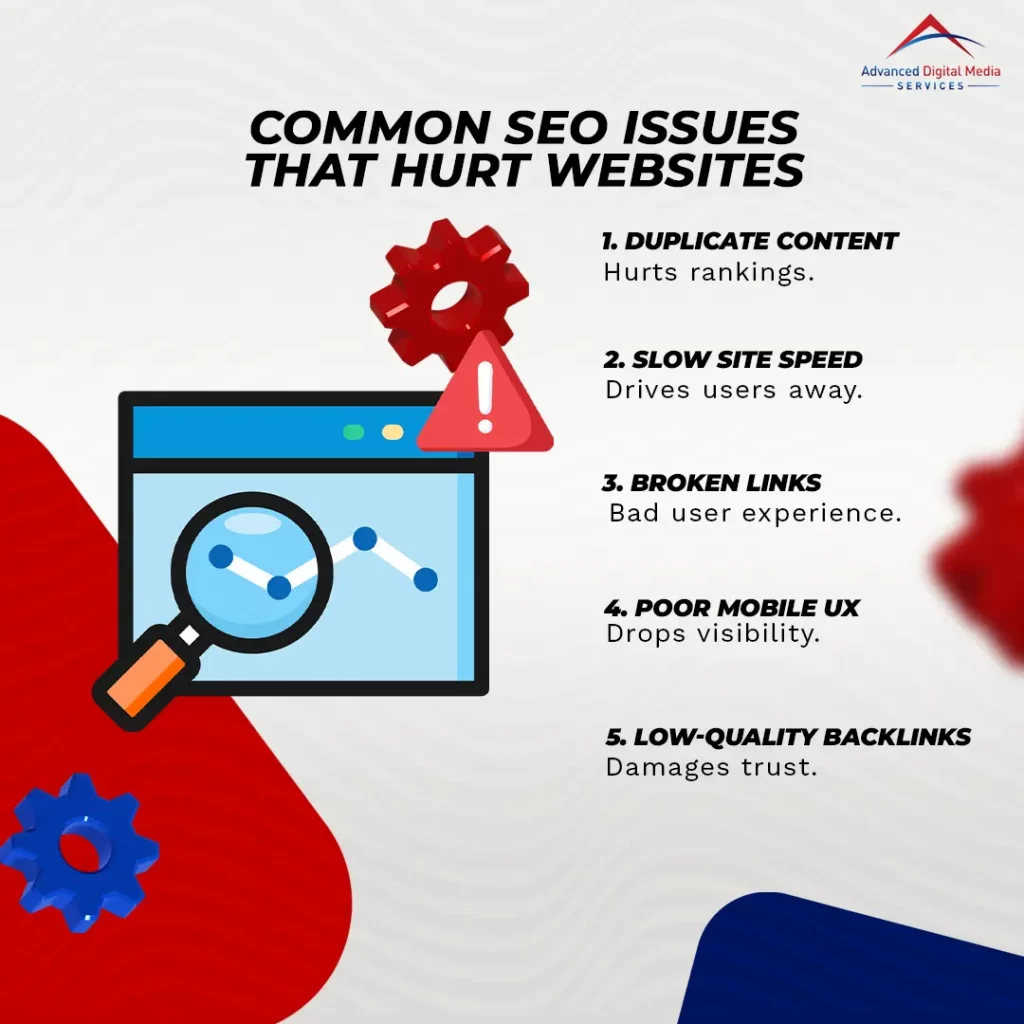
When your website suffers from poor SEO, it can greatly hinder your visibility online, leading to a decline in traffic and ultimately affecting conversions. Common website SEO problems, like slow loading times, broken links, and improper keyword usage, make it hard for search engines to rank your site. As a result, potential customers can’t find you, which means fewer visitors. Without adequate traffic, you’ll miss out on valuable leads and sales opportunities. Additionally, a lack of visibility can damage your brand’s credibility, as users often associate high search rankings with trustworthiness. Fixing these SEO issues is essential to boost your site’s performance, attract more visitors, and increase conversion rates, ensuring your business thrives in the competitive digital landscape.
The long-term cost of ignoring search optimization problems
Ignoring search optimization problems can lead to significant long-term costs for your website. If you don’t address these issues, you might face dwindling traffic, lower conversion rates, and a damaged brand reputation. Using a technical SEO audit checklist is essential to identify and rectify these problems before they escalate.
- Decreased Visibility: Your site may slip down search results, making it harder for potential customers to find you.
- Increased Marketing Costs: You may have to spend more on ads to compensate for organic traffic loss.
- Missed Opportunities: Competitors with better SEO will attract customers that could’ve been yours.
Don’t underestimate the impact of neglecting SEO; it can be a costly mistake in the long run.
Common On-Page SEO Issues and How to Fix Them
When it comes to on-page SEO, you might encounter issues like duplicate content, missing meta descriptions, or improper header structures. These problems can hurt your site’s performance and frustrate visitors. Let’s explore how to identify and fix these common issues to enhance your website’s effectiveness.
Duplicate content and missing meta descriptions
While many businesses focus on flashy designs and engaging content, overlooking duplicate content and missing meta descriptions can greatly hinder your SEO efforts. Fixing duplicate content issues is essential for improving your search ranking and user experience. Here are some steps you can take:
- Identify duplicate content using tools like Copyscape or Siteliner.
- Create unique content for each page to enhance relevance.
- Write compelling meta descriptions to improve click-through rates.
Improper header structure and keyword usage
Improper header structure and ineffective keyword usage can greatly undermine your website’s SEO potential. To fix this, make sure your headers (H1, H2, H3) are logically structured, as they guide both users and search engines through your content. Your primary keyword should appear in the H1 tag, while secondary keywords can be used in H2 and H3 tags. This hierarchy not only improves readability but also enhances keyword relevance.
Additionally, improving meta tags and descriptions is vital. Craft compelling meta descriptions that include your target keywords, as these snippets appear in search results and can greatly impact click-through rates. By addressing header structure and optimizing meta tags, you’ll be well on your way to boosting your site’s visibility and performance.
Slow-loading pages that frustrate visitors
If your website takes too long to load, you could be losing potential visitors and harming your SEO efforts. Slow-loading pages frustrate users and often lead to high bounce rates. To enhance your site speed, consider these site speed optimization tips:
- Optimize images: Compress images without losing quality to reduce loading times.
- Minimize HTTP requests: Limit the number of elements on your pages to streamline loading.
- Use a content delivery network (CDN): Distribute your content across multiple servers to speed up access for users around the globe.
Technical SEO Issues That Impact Rankings
When it comes to technical SEO, a few key issues can really hold your site back from ranking well. You might be dealing with broken links, crawl errors, or even problems with mobile-friendliness and site speed. Plus, securing your site with HTTPS is essential for building trust with both users and search engines.
Broken links and crawl errors
Although broken links and crawl errors might seem like minor issues, they can greatly hinder your website’s performance and search engine rankings. These problems can lead to a poor user experience and negatively affect your site’s credibility. Here are some steps to address broken links and their SEO impact:
- Utilize tools such as Google Search Console to detect and rectify crawl errors.
- Regularly audit your website for broken links and update or remove them.
- Implement redirects to guide users from broken links to relevant pages.
Mobile-friendliness and site speed problems
As users increasingly access websites on mobile devices, guaranteeing your site is mobile-friendly and optimized for speed is essential for maintaining strong SEO performance. Mobile-friendliness impacts how search engines rank your site, so you need to implement mobile-friendly SEO solutions. Start by using responsive design to guarantee your website adapts to different screen sizes. Additionally, minimize loading times by compressing images, leveraging browser caching, and reducing server response time. Tools like Google PageSpeed Insights can help identify specific issues affecting your site speed. Remember, a fast, mobile-friendly site not only enhances user experience but also boosts your rankings in search results. Prioritizing these factors will keep your website competitive in today’s digital landscape.
Securing your site with HTTPS
Ensuring your site is secured with HTTPS is essential not just for protecting user data but also for improving your search engine rankings. Search engines prioritize HTTPS sites, making site security for SEO a critical factor in your overall strategy. Here’s why you should make the switch:
- Enhanced Trust: Users feel safer sharing personal information on secure websites.
- SEO Benefits: Google favors HTTPS sites, potentially boosting your rankings.
- Data Integrity: HTTPS protects against data tampering and interception.
Off-Page SEO Problems You Shouldn’t Overlook
When it comes to off-page SEO, there are several key issues you can’t afford to ignore. Low-quality backlinks, inconsistent NAP information, and a lack of social proof can seriously hinder your online presence. Addressing these problems is essential for building authority and improving your search rankings.
Low-quality or spammy backlinks
While backlinks are essential for SEO, low-quality or spammy links can seriously undermine your website’s authority. It’s vital to perform an SEO health check for websites to identify and address these harmful backlinks. Here’s how you can tackle this issue:
- Audit your backlink profile: Use tools like Google Search Console or third-party software to find low-quality links.
- Disavow harmful links: If you find spammy backlinks, submit a disavow request to Google to prevent them from affecting your rankings.
- Build quality links: Focus on acquiring backlinks from reputable sites to enhance your authority and improve your SEO.
Lack of local citations and inconsistent NAP info
If your business isn’t listed consistently across local directories, you could be missing out on valuable local traffic. Inconsistent Name, Address, and Phone number (NAP) information can confuse search engines and customers alike, leading to missed opportunities. For effective local SEO, verify that your business details are accurate and uniform across platforms like Google My Business, Yelp, and Yellow Pages. Regularly audit your listings to correct discrepancies and add new citations as needed. This not only boosts your local rankings but also builds trust with potential customers. Remember, consistency is key; the more reliable your information, the better your chances of attracting local clientele and improving your online presence.
Missing social proof that builds authority
How can you establish your business as a trusted authority in your industry? One key element is social proof, which can greatly enhance your credibility. If you’re missing testimonials, reviews, or case studies, potential customers may hesitate to choose your services.
Consider these strategies to build social proof:
- Gather customer testimonials: Showcase positive feedback prominently on your website.
- Leverage social media: Share user-generated content and engage with your audience to create a community.
- Showcase case studies: Highlight successful projects that demonstrate your expertise.
Additionally, while you’re at it, make sure to address technical issues like resolving crawl errors in Google Search Console. A well-rounded approach can greatly boost your authority and online presence.
Boost Your Website’s Performance with Advanced Digital Media Services
If you’re looking to enhance your website’s performance, Advanced Digital Media Services has got you covered. They offer thorough SEO audits to identify hidden issues and develop customized strategies for on-page, technical, and off-page optimization. Contact ADMS today to boost your rankings and grow your online presence.
Comprehensive SEO audits to uncover hidden issues
When you’re looking to enhance your website’s performance, conducting an extensive SEO audit can reveal hidden issues that may be hindering your online success. These audits help identify areas needing improvement, guaranteeing your site is optimized for search engines. Pay particular attention to structured data and schema fixes, as they can notably impact your visibility.
Here are some key aspects to focus on during your audit:
- Technical issues: Check for broken links, slow loading times, and mobile responsiveness.
- Content evaluation: Verify your content is relevant, engaging, and keyword-optimized.
- Backlink analysis: Examine your backlinks to identify toxic links and opportunities for improvement.
Addressing these issues will set you on the right path to achieving better search rankings and user engagement.
Customized strategies for on-page, technical, and off-page optimization
After identifying issues through a thorough SEO audit, the next step is implementing customized strategies that address on-page, technical, and off-page optimization. For on-page SEO, focus on optimizing content, meta tags, and internal linking to enhance user experience and search visibility. Technical SEO involves ensuring your website’s speed, mobile-friendliness, and crawlability are exceptional. Address any keyword cannibalization issues by consolidating similar content and assigning primary keywords to specific pages, which helps improve your site’s authority. Off-page optimization revolves around building quality backlinks and engaging in social media to boost brand awareness. Tailoring these strategies to your specific needs will greatly enhance your website’s performance and lead to better rankings in search results.
Contact ADMS today to improve your rankings and grow your online presence
Boosting your website’s performance is just a call away with Advanced Digital Media Services. By partnering with us, you can enhance your search rankings and grow your online presence effectively. We specialize in tailored strategies that include essential elements like image optimization for SEO, ensuring your visuals contribute to your site’s visibility.
Here’s what you can expect when you contact ADMS:
- Thorough SEO audits to identify key issues
- Customized plans that focus on your specific needs
- Ongoing support and analysis to track your progress
Don’t let your online potential go untapped. Reach out to Advanced Digital Media Services today, and let’s work together to elevate your brand and achieve lasting success.
Frequently Asked Questions
How Long Does It Take to See SEO Improvements?
SEO improvements can feel like waiting for a glacier to melt, but typically, you’ll see noticeable changes within 3 to 6 months. Patience and consistent effort are key to achieving the best results.
Can I Fix SEO Issues Myself or Should I Hire an Expert?
You can fix SEO issues yourself if you’re willing to learn, but hiring an expert often yields faster, more effective results. Their experience can save you time and guarantee your strategies are up-to-date and effective.
What Tools Can Help Identify SEO Problems?
To identify SEO problems, you can use tools like Google Search Console, SEMrush, Ahrefs, and Moz. These platforms provide insights into site performance, keyword rankings, backlinks, and technical issues, helping you optimize effectively.
How Often Should I Conduct SEO Audits?
You should conduct SEO audits at least quarterly. However, if you’re making significant changes to your website or strategy, consider performing them more frequently to guarantee everything’s optimized and aligned with your goals.
Are SEO Fixes a One-Time Task or Ongoing?
SEO fixes aren’t a one-time task; they’re ongoing. You’ll need to regularly monitor, update, and adjust your strategies to keep up with algorithm changes and guarantee your site remains optimized for search engines.
Conclusion
In the digital world, neglecting search engine optimization is like leaving a treasure trove untouched—you’re forfeiting the benefits of increased visibility and traffic. By addressing on-page, technical, and off-page issues, you can unlock your website’s full capabilities. Every minor adjustment contributes to substantial improvements in your search engine standing. Take immediate action and witness your digital footprint thrive, as your success is merely a few refinements away!