Domain Authority (DA) measures your entire website’s strength, while Page Authority (PA) focuses on the ranking potential of individual pages. DA is influenced by overall backlinks and site quality, whereas PA is determined by specific page backlinks and content quality. Both scores help gauge your SEO performance, with DA indicating overall visibility and PA evaluating specific page rankings. Understanding these differences can enhance your SEO strategy, leading to better results for your website’s performance. There are more insights to discover!
Key Takeaways
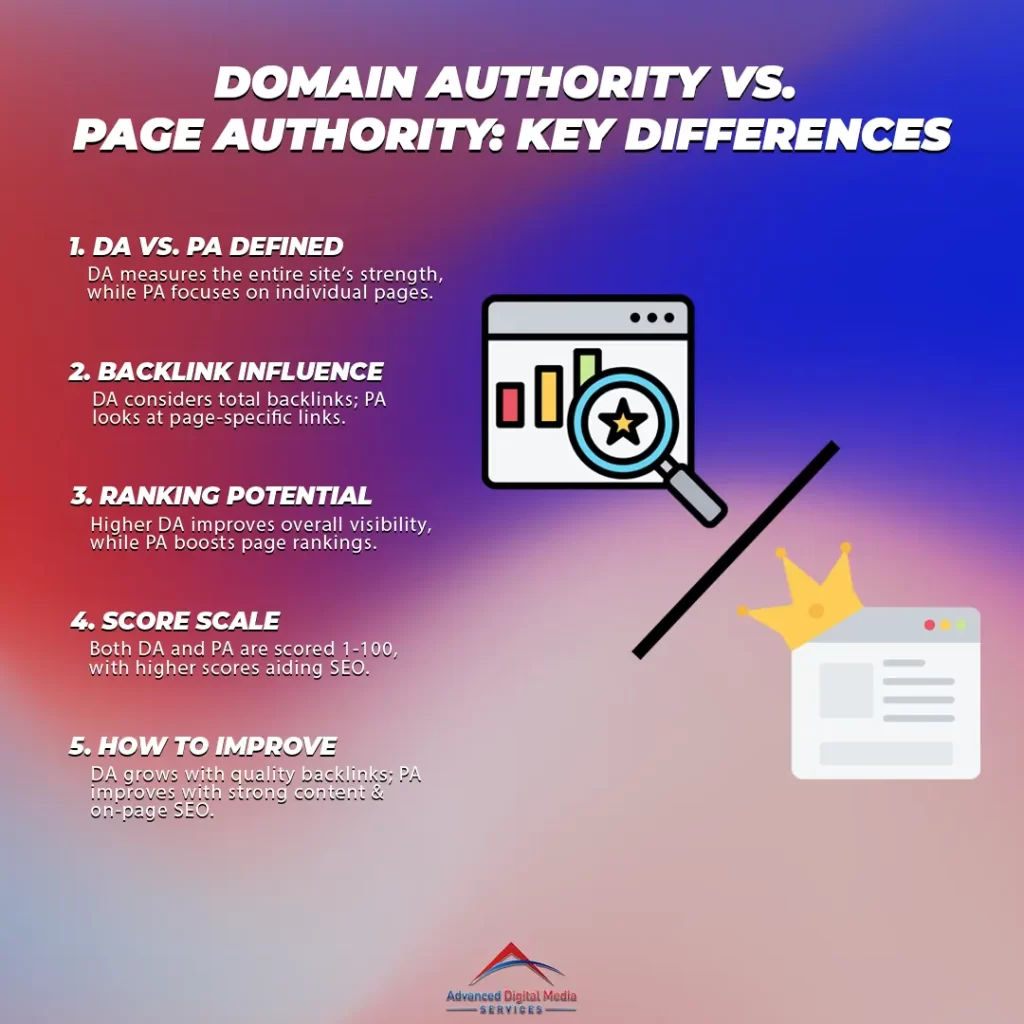
- Domain Authority (DA) measures the overall strength of a website, while Page Authority (PA) assesses the strength of an individual page.
- DA is influenced by the total number of backlinks to the domain, whereas PA focuses on backlinks specifically to the individual page.
- A higher DA indicates a potential for better visibility and traffic for the entire site, while a higher PA enhances the ranking ability of specific pages.
- Both DA and PA are scored on a scale from 1 to 100, with higher scores indicating greater potential for ranking well in search results.
- Strategies to improve DA include building quality backlinks and optimizing content, while PA can be enhanced through targeted keyword optimization and page-specific strategies.
Understanding Domain Authority and Page Authority
When you’re maneuvering the world of SEO, understanding Domain Authority (DA) and Page Authority (PA) is essential. DA measures the overall strength of your website, while PA focuses on the ranking potential of individual pages. Let’s break down how each is calculated and what sets them apart.
What is Domain Authority and How is it Calculated?
Domain Authority (DA) serves as an essential metric in search engine optimization, reflecting a website’s likelihood to rank in search results. The domain authority definition encompasses a score ranging from 1 to 100, with higher scores indicating a greater potential to rank well. So, what is domain authority, and why is it important? It’s vital because it helps you gauge the strength of your website compared to competitors. DA is calculated based on various factors, including the number of backlinks, linking root domains, and overall site quality. By understanding and improving your DA, you can enhance your chances of achieving higher visibility on search engines, ultimately driving more traffic to your site.
What is Page Authority and How Does it Differ from DA?
Although often confused, Page Authority (PA) is a distinct metric that measures an individual page’s ability to rank in search engine results. Unlike Domain Authority (DA), which assesses an entire domain’s ranking potential, PA focuses solely on a specific page’s strength. When you look at domain authority vs page authority, it’s crucial to understand that PA considers factors like content quality, backlinks, and social signals for that particular page. DA provides a broad assessment of your website’s credibility, whereas PA scrutinizes the performance of specific pages. To refine your SEO approach, it’s crucial to consider both metrics, as grasping domain authority and page authority will enable you to concentrate your efforts more precisely.
Key Factors That Influence Domain Authority and Page Authority
When it comes to boosting your Domain Authority and Page Authority, two key factors stand out: backlinks and content quality. You need to understand how these elements work together to enhance your site’s credibility. Let’s explore how strong backlinks and high-quality content can make a difference in your authority scores.
The Role of Backlinks in Authority Scores
Backlinks play a significant role in determining authority scores, as they signal to search engines the credibility and relevance of your site. The more high-quality backlinks you have, the higher your domain authority and page authority can rise. Here’s what to keep in mind:
- Quality over quantity: Focus on obtaining backlinks from reputable sites.
- Diversity matters: A varied backlink profile enhances your authority.
- Relevance counts: Links from sites within your niche boost your credibility.
If you’re wondering how to check domain authority and page authority, many tools are available online. Monitoring your backlinks and their quality is essential for improving your scores and ultimately your search engine rankings.
Content Quality and Its Impact on DA and PA
While it’s easy to focus on backlinks, the quality of your content plays a crucial role in shaping both domain authority (DA) and page authority (PA). High-quality content not only engages your audience but also encourages them to share it, leading to more backlinks organically. This engagement signals to search engines that your site is a valuable resource, which can enhance your DA and PA over time. To effectively learn how to increase domain authority and page authority, prioritize creating informative, relevant, and well-structured content that addresses your audience’s needs. By investing in content quality, you’re not just improving your rankings; you’re building trust and authority in your niche, setting you up for long-term success.
How Domain Authority and Page Authority Affect SEO
When it comes to SEO, understanding the impact of Domain Authority (DA) and Page Authority (PA) is essential. You might wonder which metric holds more weight for your rankings and how you can leverage both to enhance your SEO strategy. Let’s break down how these scores can influence your search visibility and what steps you can take to improve them.
Which Metric Matters More for Ranking in Search Results?
Understanding how Domain Authority (DA) and Page Authority (PA) contribute to your website’s SEO is essential for improving your search rankings. You might be wondering what’s the difference between page authority vs domain authority and which one truly matters more.
- Domain Authority reflects the overall strength of your entire domain.
- Page Authority assesses the potential ranking ability of individual pages.
- Both metrics are vital, but their importance can vary based on your specific goals.
Using a domain authority and page authority checker can help you gauge where you stand. Ultimately, focusing on both metrics can enhance your SEO strategy and increase your visibility in search results.
How to Use DA and PA to Improve SEO Strategy
To effectively improve your SEO strategy, it is crucial to recognize how both Domain Authority (DA) and Page Authority (PA) shape your website’s performance. Understanding domain authority explained helps you gauge your overall site strength, while PA focuses on individual pages. So, what is domain authority and page authority in SEO? DA measures the likelihood of your entire domain ranking well, while PA indicates how likely a specific page will rank. To leverage these metrics, aim to increase your DA through high-quality backlinks and content. Simultaneously, optimize your PA by enhancing on-page SEO elements like titles, keywords, and user experience. By balancing both, you can create a robust strategy that boosts your visibility and engagement in search results.
Strategies to Improve Both Domain Authority and Page Authority
To boost both Domain Authority and Page Authority, you’ll want to focus on building high-quality backlinks and optimizing individual pages. Strong backlinks signal credibility to search engines, while well-optimized pages can improve your PA scores. Let’s explore these strategies to elevate your site’s authority effectively.
Building High-Quality Backlinks for Stronger Authority
While building high-quality backlinks is often seen as an intimidating task, it’s essential for enhancing both Domain Authority and Page Authority. Quality backlinks signal to search engines that your site is trustworthy and valuable. Here are some effective strategies to achieve this:
- Guest Blogging: Write informative posts for reputable sites in your niche.
- Create Shareable Content: Develop infographics or detailed guides that others want to link to.
- Network with Influencers: Connect with industry leaders who can share your content.
Optimizing Individual Pages for Better PA Scores
Building high-quality backlinks is just one part of the equation when it comes to improving your site’s authority. To enhance your Page Authority (PA), focus on optimizing individual pages with relevant keywords, compelling content, and proper meta tags. It’s essential to understand the difference in page authority vs domain authority; while domain authority reflects your entire site’s credibility, PA assesses the strength of each page. Why is domain authority important? A higher domain authority can lead to better overall rankings, making it easier for your key pages to shine. Regularly update your content and guarantee your site’s structure is user-friendly. This strategic approach not only boosts PA but can also positively influence your site’s domain authority over time.
Frequently Asked Questions
What Tools Can I Use to Check Domain Authority and Page Authority?
You can use tools like Moz’s Link Explorer, Ahrefs, and SEMrush to check domain authority and page authority. They provide valuable insights into your website’s performance and help optimize your SEO strategies effectively.
Can Domain Authority and Page Authority Be Manipulated?
You can’t always judge a book by its cover. While you might think you can manipulate domain and page authority, search engines are smart. Sustainable growth comes from genuine SEO practices, not shortcuts.
How Often Do Domain Authority and Page Authority Scores Update?
Domain Authority and Page Authority scores regularly update, typically every few weeks. However, you won’t always notice significant changes immediately, as these scores reflect long-term trends in your website’s performance and link profile.
Is a Higher Domain Authority Always Better for SEO?
Imagine a tree towering high, its roots deep. A higher domain authority can help your SEO, yet it’s not the only factor. Quality content and engagement are essential for flourishing in the digital forest you seek.
Do Social Media Signals Influence Domain Authority and Page Authority?
Yes, social media signals can influence both domain and page authority indirectly. When your content gets shared, it boosts visibility, potentially attracting backlinks and traffic, which can enhance your SEO performance over time.
Conclusion
Just like a tree needs strong roots to grow tall, your website needs both Domain Authority and Page Authority to flourish in the digital landscape. By nurturing these metrics, you’re not just planting seeds for better visibility; you’re cultivating a thriving ecosystem where each page can stand tall. As you embark on your path to search engine optimization, every step matters—nurture your foundation, and witness your digital footprint flourish.